Country
 Kingdom of Hungary
 Austrian Empire
 Austria-Hungary
County
 Bratislava County
Titles
a nobleman
chevalier (vitéz)
baron
An ancient ancestor
Mauricio
Century
15th centuryMaternal dynasty
possibly of Czech origin
Branches
Morocz de Beketfalva
Morocz de Nagyabony
Internal links
External links
The Forgotten Hero of Kolín: The Rise and Glory of Baron Imrich Mórocz
Imperial Lieutenant Field Marshal Emericus Leopoldus Mórocz, Baron de Beketfalva, is one of those 18th-century figures upon whom the dust of oblivion has settled. Nevertheless, his life story embodies a fascinating journey from an impoverished nobleman from Pressburg to an elite general who enjoyed the personal favor of Maria Theresa.
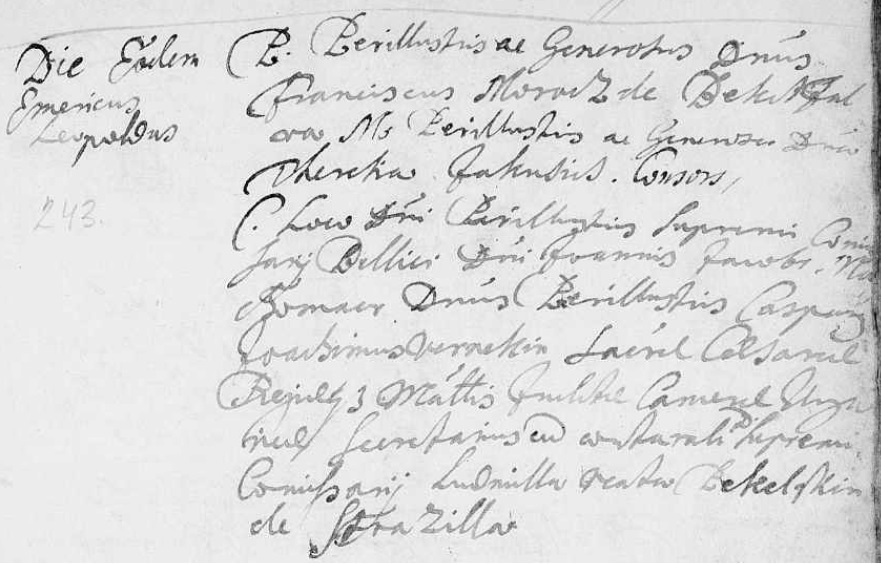
Baptism record from 1697
Origins and Uncertain Beginnings
I mrich was born in 1697 in Pressburg (modern-day Bratislava) into the ancient lineage of Mórocz de Beketfalva, with roots tracing back to the Rye Island. Although the family had been previously brought to fame by Vice-Palatine Wolfgang Mórocz, by the time of Imrich’s birth, the family was financially exhausted.
The son of Francis (Ferenc) Mórocz and Baroness Eva Terézia Jakusith began his career in a civil capacity. In 1727, he served as a clerk at the court of the influential Count Pálffy, the Count-Palatine of Pressburg. It was likely this dire financial situation and a desire to restore his family's honor that prompted him to trade his quill for a saber and join the army.
The Turning Point: Messenger of Good Tidings
I mrich Mórocz’s military career gained rapid momentum during the War of the Austrian Succession. As a soldier, he proved himself with extraordinary bravery. By 1741, he was already commanding the Ghyllány regiment as a colonel, operating in Bohemia, Silesia, and the Rhineland.
The pivotal moment of his life occurred in July 1744. After the successful capture of the Lauterburg lines, he was chosen to personally deliver the news of the victory to Maria Theresa in Vienna. The Empress, grateful for good news during the arduous years of war, immediately promoted him to General. From that moment on, Mórocz became her "persona grata," and his career began its ascent to the heights of the military hierarchy.
A General in the Fire of the Seven Years' War
M órocz’s reputation as a strategist was fully confirmed during the Seven Years' War (1756–1763), one of the bloodiest conflicts between the European powers of the era.
- Battle of Kolín (1757): In this fateful battle, where Austria dealt the first major defeat to the Prussian King Frederick II the Great, Mórocz fought in the corps of General Nádasdy.
- Reserve Commander: He later took command of the reserve forces, penetrating as far as Saxony. There, thanks to his mobility, he effectively disrupted the retreat of enemy troops and inflicted significant losses.
- Career Finale: He concluded his military path and strategic mastery in the battles of Breslau (Wrocław) and Leuthen, which rank among the largest and most significant clashes of this historical epoch.
Proprietor of the 10th Hussar Regiment: An Esthete in the Saddle
The highest recognition came to Imrich Mórocz on November 1, 1754, when he was appointed the Proprietor (Inhaber) of the 10th Hussar Regiment. He took command of the famous Beleznay hussars and border guard units.
Mórocz was not only a tough soldier but also a man who cared for prestige and the smallest details:
- Uniform Reform
- He introduced exceptionally ornate uniforms with gold braiding and large silver buttons. This gave rise to a proud tradition and the proverb: "The uniform of a hussar officer is equal to a German estate."
- Grooming Standards
- He strictly enforced discipline regarding appearance. He abolished the then-common practice of wearing braids on both sides of the face—ordering a single braid in the back and hair at the temples styled into elegant curls.
- Jurisdiction Rights
- As the regiment's proprietor, he held judicial power over all his men. Interestingly, he delegated this authority for rank-and-file soldiers to the regimental commander, while reserving the right to decide exclusively on matters involving officers.
The End of the Line
D espite his meteoric social rise and closeness to the Imperial Court, Imrich Mórocz remained devoted to the military life. He never married and left no heirs. He died relatively young at the age of 59 in 1758, shortly after his greatest battles.
Although there was no one to inherit his hard-won titles and estates, his name remains inscribed in history as a symbol of the courage of the Hungarian nobility and the golden age of the Austrian hussars.
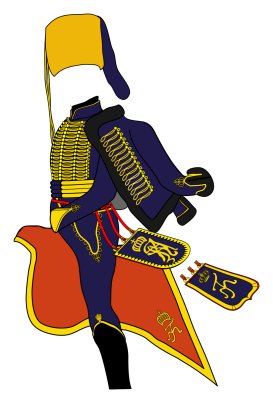
Uniform of the 10th Hussar Regiment