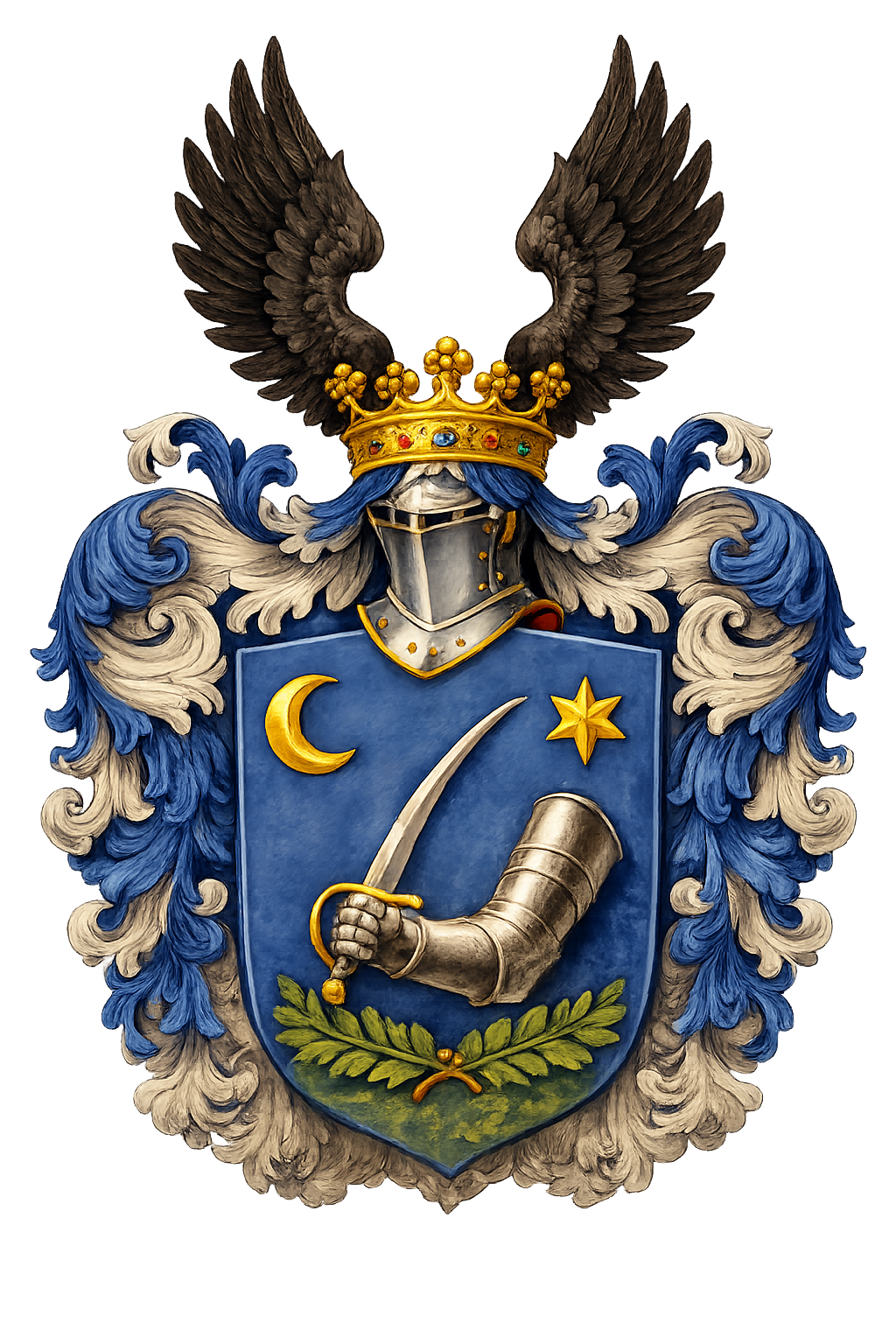
Ambrosius Mórocz: Defender of Great Rye Island and Architect of Lineage Stability
Ambrosius Mórocz (Morocz Ambrus) was not merely a passive witness to the turbulent history of the 17th century; he became a strategic builder and a true "living bulwark" of the Kingdom of Hungary. As a member of the elite nobility, he stood on the front lines defending the Christian world against Ottoman expansion, earning not only the respect of his peers but also the extraordinary favor of the Sovereign himself. Although his exact date of birth is not preserved, based on the pivotal year 1641, when he received the Nova Donatio (New Donation), and subsequent legal disputes in 1650, we can estimate his birth between 1600 and 1610. He spent his most active years during the mid-17th century, leaving an indelible mark on the history of Great Rye Island (Csallóköz).
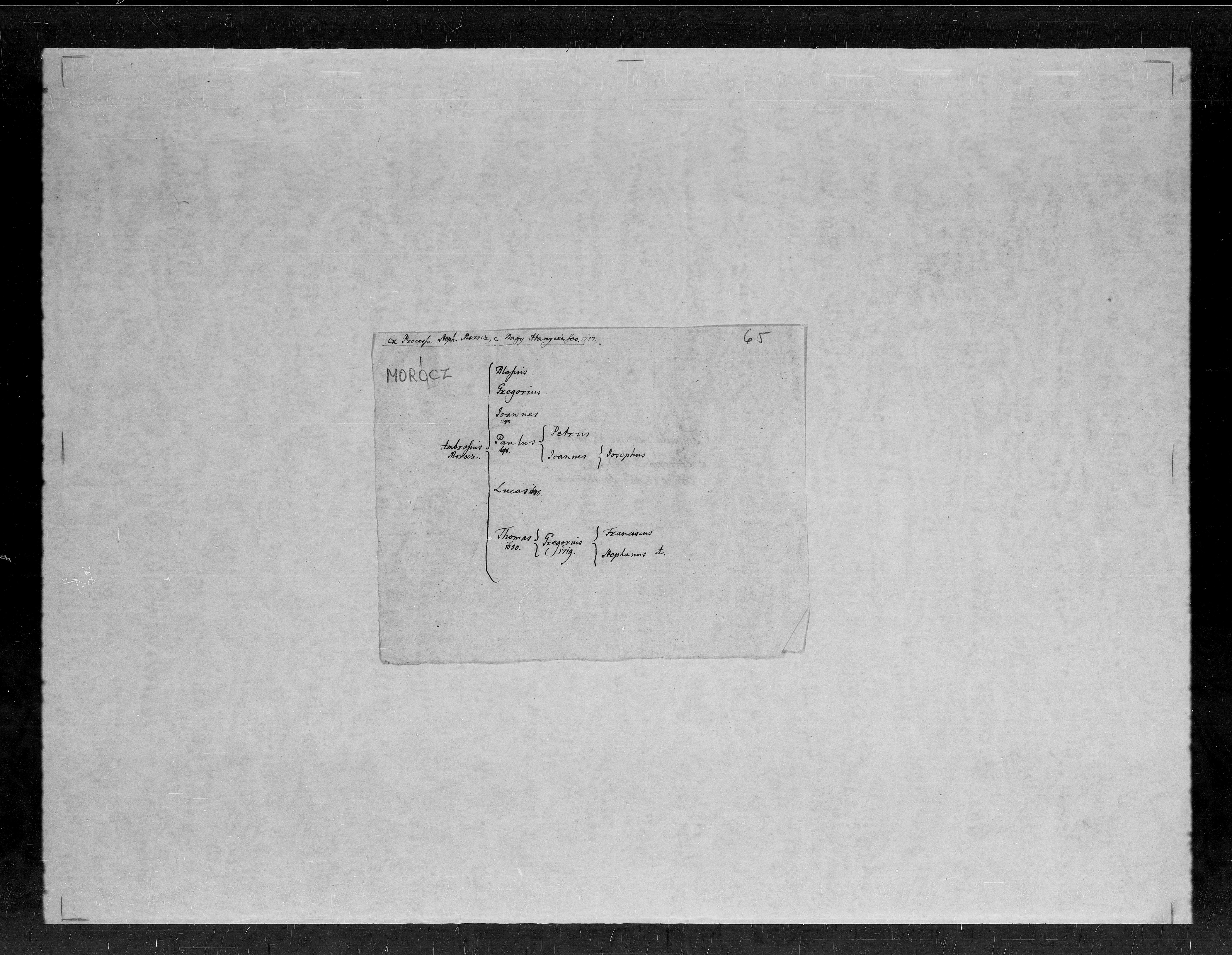 Family Tree of Ambrosius Mórocz de Nagyabony
This historical genealogical sketch from 1757 captures the direct lineage of Ambrosius Mórocz and documents his sons, who became the continuators of the house in Nagyabony and later in the village of Eperjes (Jahodná). The graphical rendering confirms the family's continuity across four generations, from Ambrosius to his great-grandchildren, thereby proving the successful fulfillment of the Royal Donation intended for male offspring (agnatic succession). It serves as key genealogical evidence that, by linking names such as Paulus, Lucas, Thomas, and Joannes, visualizes the stability and expansion of the influential Mórocz noble lineage.
His extraordinary position in the hierarchy of contemporary society is confirmed by official period records, in which Ambrosius appears with titles that clearly placed him above the common gentry. As a bearer of the title Nobilis (Nobleman), he enjoyed full personal liberty and was subject to the direct jurisdiction of the King alone. Even more significant, however, is the honorary prefix Egregius (Distinguished/Eminent), which was not used for every nobleman. This title was reserved only for the respected landed gentry who held dominant property influence in the region and occupied important offices in the administration of Pressburg County. Ambrosius Mórocz was thus not just a landowner, but a recognized regional authority with direct ties to the Royal Court.
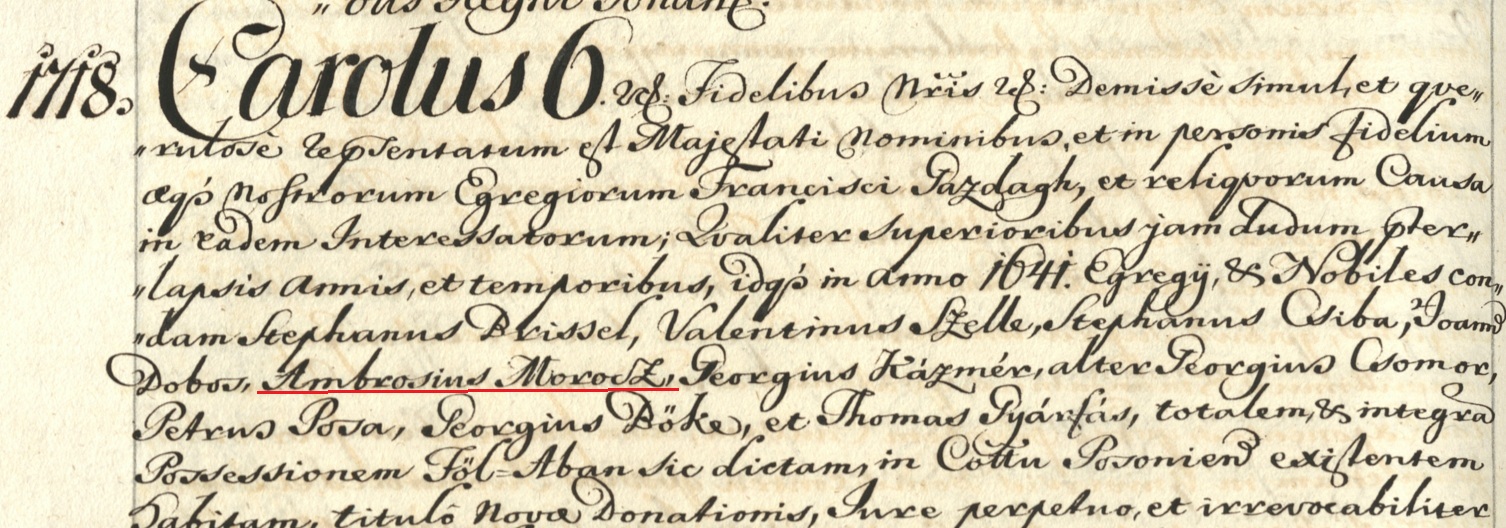 Nova Donatio 1641 Ambrosius Mórocz
This period Latin document, dated 1718, is a key testament to the noble status and property claims of the Mórocz lineage. In the text, which refers to the original donation of 1641, the name of the ancestor Ambrosius Morocz is clearly identifiable (underlined in red). Of particular importance is the collective designation of the persons in the list as Egregij & Nobiles (Distinguished and Noble), located on the line directly above Ambrosius's name. This combination confirms their high social status and the direct recognition of their noble privileges by the Monarch. The document further specifies that it concerns the possession of estates in the locality of Föl-Aban (Nagyabony) in Pressburg County (Comitatu Posoniensi), granted by King Ferdinand III in perpetuity.
Border Knight in the Végvár System
Ambrosius Mórocz was not merely a landowner; he was a "Végvári vitéz" – a border warrior. In that era, Nagyabony was not just a quiet village, but a key strongpoint within the border fortress system (Végvár). Together with his allies from the Brissel, Szelle, Csiba, Dobos, Kázmér, Csomor, Posa, Bőke, and Gyárfás lineages, he formed a strategic barrier designed to protect Great Rye Island, especially the vital sector near Nadvár (Udvarhely). Had the enemy breached this line, the path to Pressburg and Vienna would have remained defenseless.
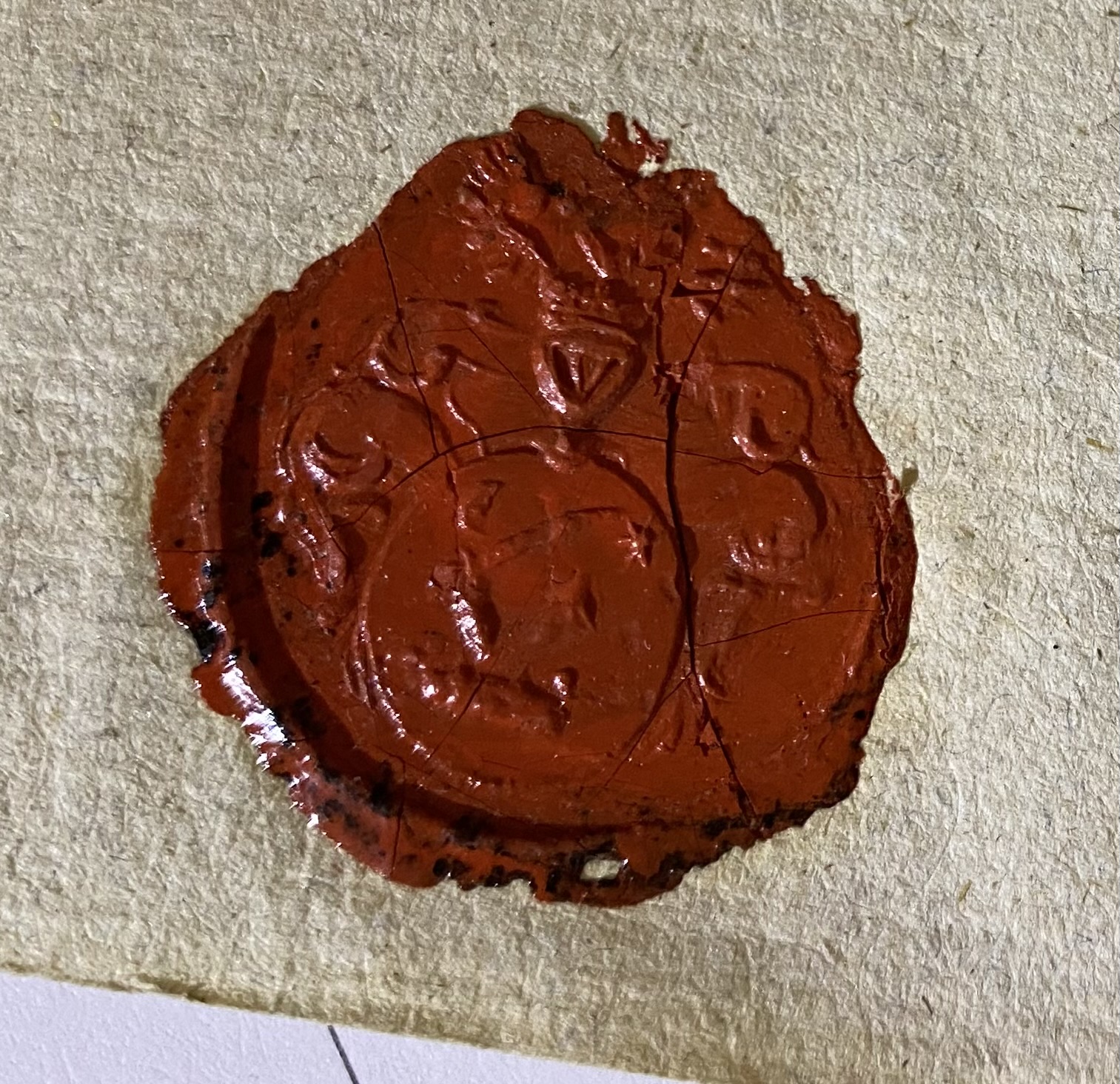 Armorial Seal from 1823 - Mórocz de Nagyabony
This rare ancestral seal is an authentic testament to the deep roots and noble identity of the Mórocz lineage. Its heraldic composition carries a clear message regarding the family's origin and mission on Great Rye Island. The central motif of the coat of arms is an armored arm wielding a sword, which does not emerge from a standard crown but symbolically rises from a green branch, emphasizing the family's connection to their ancestral land and traditions. This scene is flanked by a star and a crescent moon—traditional symbols of vigilance and valor during the anti-Ottoman wars. Of particular significance is the crest, where outspread eagle wings dominate above the noble coronet. In heraldry, these represent not only power and protection but are primarily a reference to the noble antiquity of the house. The wings declare that the Mórocz family belongs to the ancient nobility whose roots and privileges reach deep into the history of the Kingdom of Hungary. The entire seal, in conjunction with the title "Egregius et Nobilis," confirms that Ambrosius Mórocz was the bearer of a legacy that built the authority and stability of his lineage for centuries.
As a holder of a Royal Donation, Ambrosius was obligated under the noble levy (Insurrectio) to maintain constant military readiness. This meant keeping horses, weapons, and armor prepared for immediate action against Ottoman raiding parties. In practice, his manor functioned as a small fortress, providing guard and signaling services, monitoring enemy movements, and giving timely warnings to the interior of impending danger.
The New Donation (1641): A Reward for Blood and Loyalty
A turning point came in 1641, when Ambrosius received a so-called New Donation (Nova Donatio) from King Ferdinand III for the estates in Nagyabony. This grant was a direct result of his "faithful services" (fidelia servitia). Through this act, the King collectively confirmed ten noble families in their ancient medieval holdings and solidified the system of noble co-possession (common tenancy), making these lineages the sole lords of Nagyabony. Ambrosius earned this confirmation by maintaining the village as a functional part of the defense during the period of Ottoman pressure and by supporting the Crown both financially and militarily.
Victorious Defender of the Ancestral Heritage
In 1650, Ambrosius successfully defended his claims in the court of Pressburg against opponents. Thanks to the precisely secured royal charter, he definitively "locked" the property for his male offspring (pro sexu masculino). His foresight served his grandsons decades later as an impenetrable shield of protection under the auspices of King Charles III, thereby securing the stability of the lineage for several centuries.
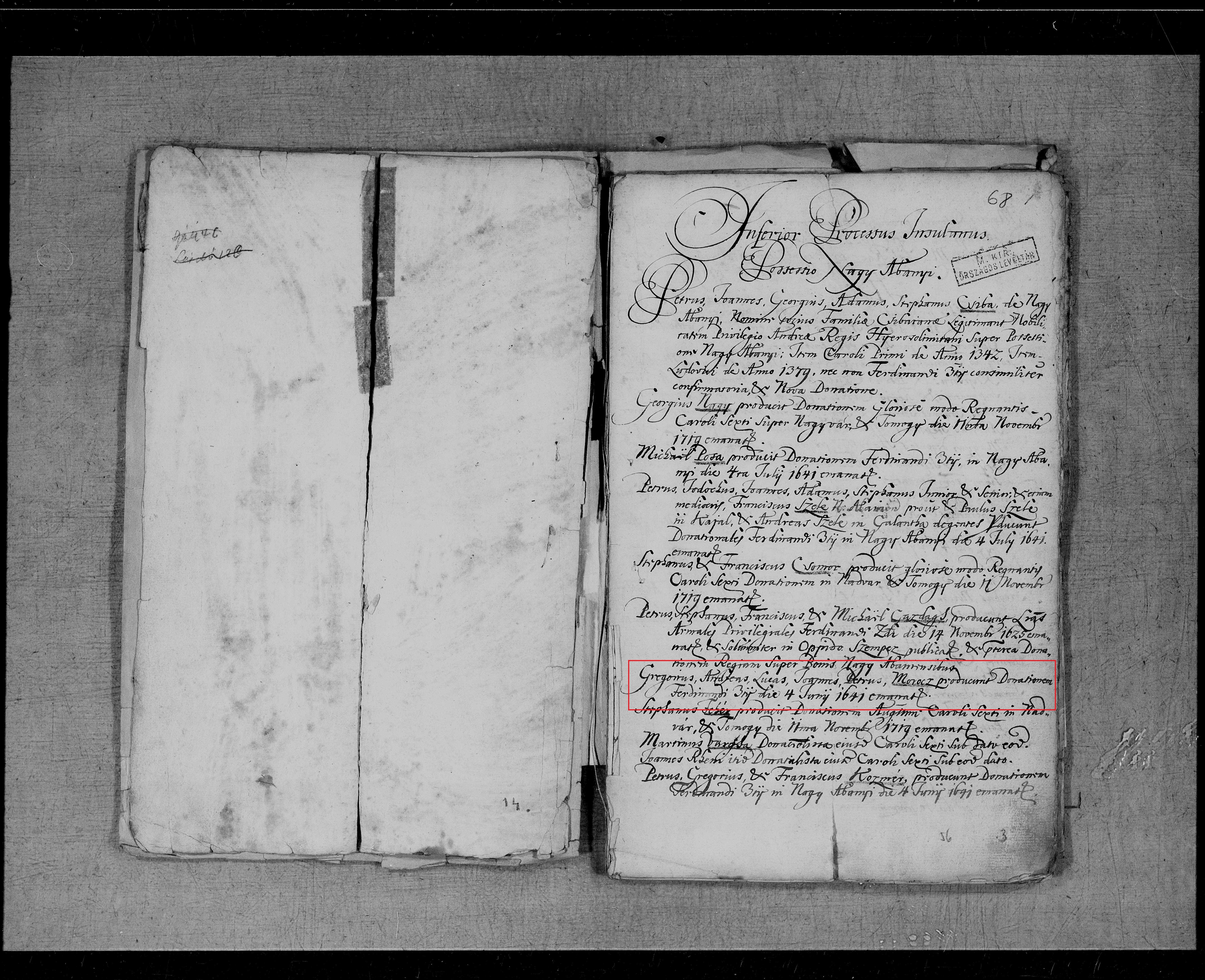 Record of the 1641 Donation for Ambrosius Mórocz
This authentic document from 1725 represents a key legal record in which the grandsons of Ambrosius Mórocz present their grandfather's royal donation. The text states that Gregorius, Andreas, Lucas, Joannes, and Petrus Morocz "produce" (submit) the donation of King Ferdinand III, issued on June 4, 1641, for the estates in Nagy Aban (Nagyabony). This entry is irrefutable proof that Ambrosius's foresight from the mid-17th century bore fruit even 84 years later. Through this act, his grandsons successfully defended their hereditary rights and the legitimacy of their noble status, referring directly to the document their ancestor had secured for his "faithful services" to the Crown. The record confirms the unity of the family and the stability of the property background that Ambrosius built for his male descendants.
Confirmation of Lineage Continuity (1725): The Grandsons of Ambrosius Mórocz
Ambrosius's grandsons thus successfully defended their hereditary rights and noble legitimacy, relying directly on the charter their ancestor had won for his "faithful services" to the Crown. The record attests to the family's unity and the stability of the ancestral estates that Ambrosius established for his male offspring (agnatic line) within the elite group of Nagyabony landowners.
A Legacy for Descendants: The Royal Shield of the House
Ambrosius Mórocz was a visionary founder of ancestral stability. In the chaos of the 17th century, he secured the Royal Seal, defended Great Rye Island with his sword, and ensured land, respect, and an unquestionable status for his family. For centuries, every subsequent bearer of the Mórocz name has relied on the firm foundations that Ambrosius fought for on both the battlefield and in the courts of law.
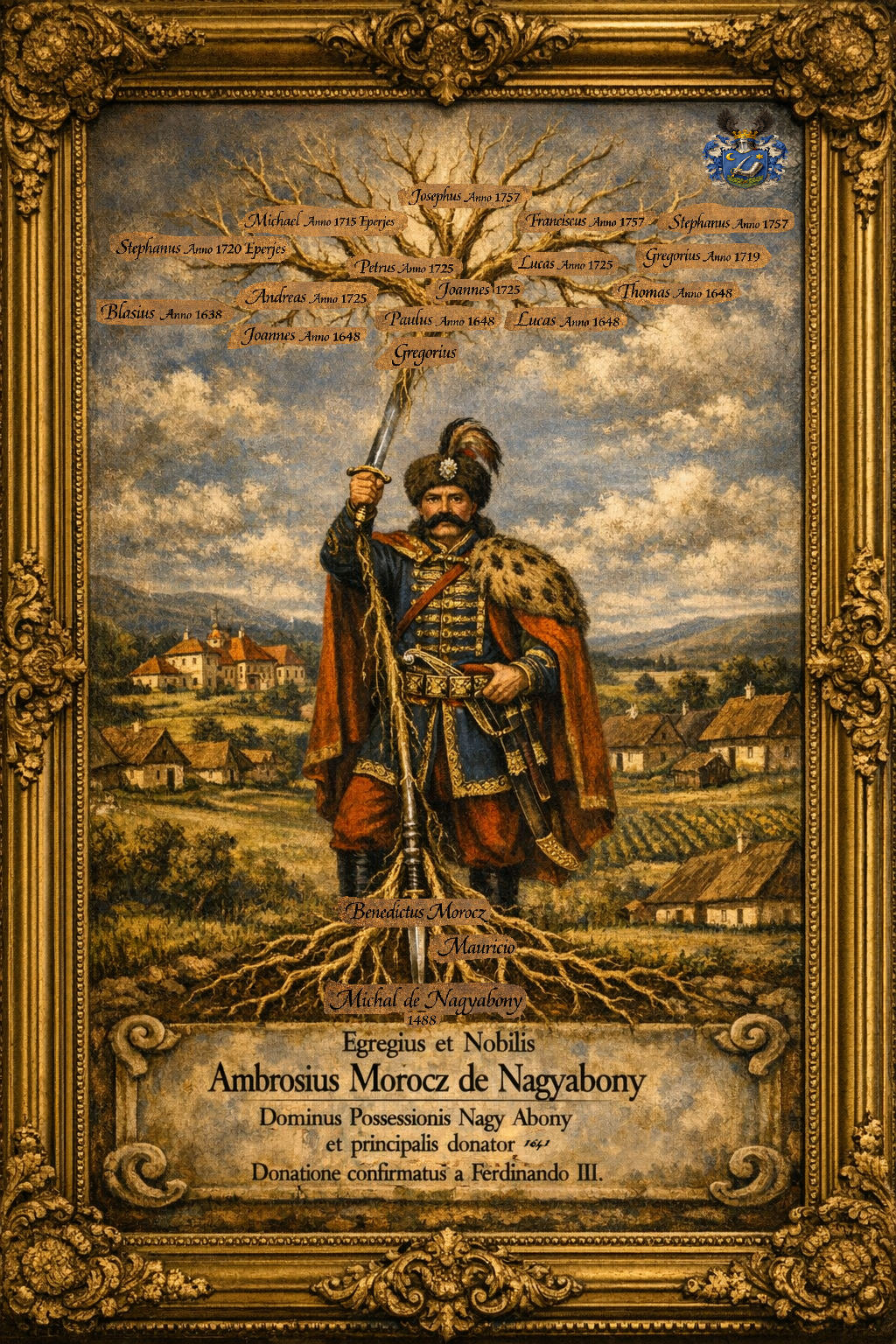 Pictorial Family Tree of the Immediate Family of Ambrosius Mórocz
This portrait-style family tree artistically depicts Ambrosius Mórocz as the central figure and "trunk" of the lineage. He is shown as a proud nobleman and warrior in period attire with fur trim, holding a sword from which branches grow bearing the names of his descendants. In the upper section (the tree's crown), we see the names of sons and grandsons with significant years and locations, such as Michael (1715 Eperjes) and Stephanus (1720 Eperjes), documenting the expansion of the house from Nagyabony to Jahodná. The roots reach back to ancestors like Michael de Nagyabony (1488), emphasizing the noble antiquity of the house. The lower part contains a Latin inscription confirming his status as Egregius et Nobilis, his title as Lord of Nagyabony (Dominus Possessionis Nagy Abony), and commemorates the pivotal donation from King Ferdinand III. In the background, a noble manor and manorial seat are depicted, representing the family's economic foundation.
The ultimate confirmation of his foresight came in 1718, when King Charles III issued special Letters of Protection (Salva Guardia). In this document, the Monarch took the heirs of Ambrosius, their persons, and all their property under his direct Royal Protection (in Nostram Regiam Protectionem). He declared any attack on the rights of the Mórocz family to be an attack on the Royal Crown itself, definitively anchoring the legacy of Ambrosius as inviolable.
Inquire / Share
Would you care to share your knowledge regarding the House of Mórocz de Nagyabony, or do you have inquiries concerning this lineage? Pray, send us a message.