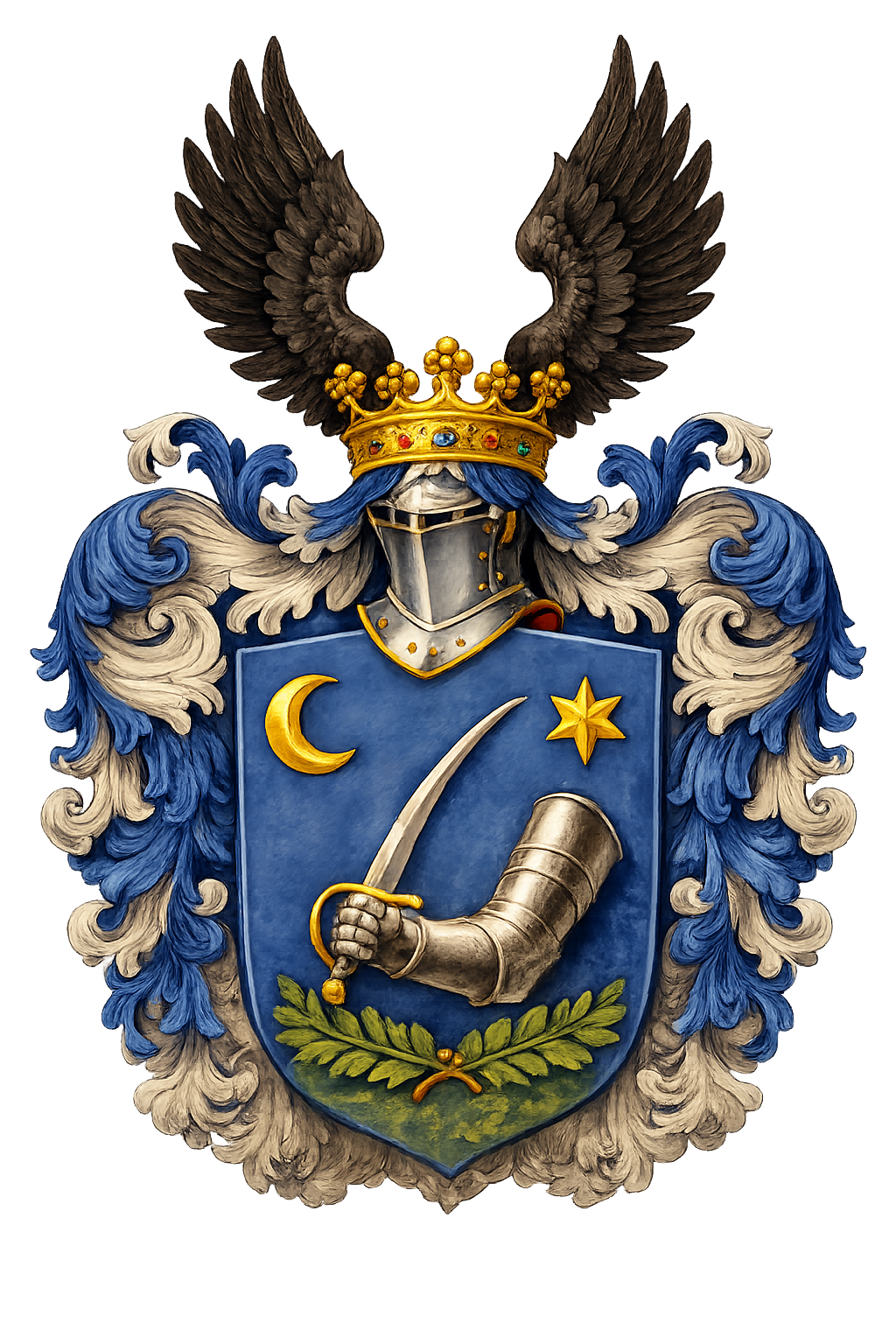
Family Origins and the Emergence of the Surname
The first historically documented member of the lineage to adopt the surname Mórocz at the beginning of the 16th century was Benedict (Benedictus Morocz de Naghaban). The surname was established in a patronymic manner—Benedict derived it from the given name of his father, Mauritius (Móricz).
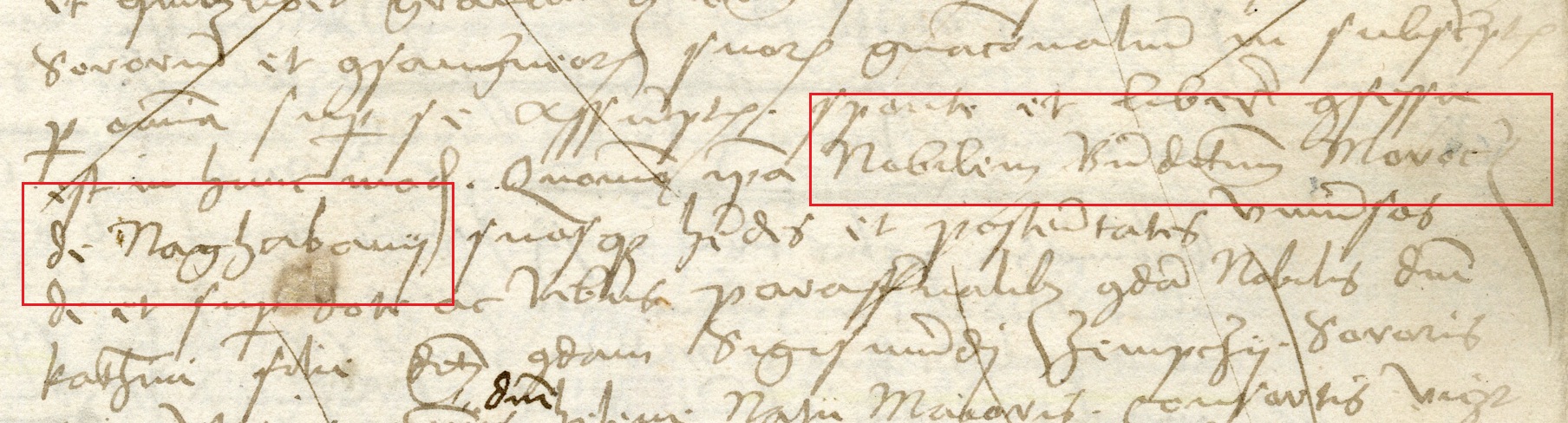 Nobilium Benedictum Morocz de Naghabany - 1518
A document from 1518, serving as an exceptionally rare proof of the transition from Mauritius's cognomen to Benedict's surname. The entry in the text confirms the noble Mórocz lineage in direct connection with their ancestral seat, Nagyabony (Veľké Blahovo).
From a genealogical perspective, Benedict represents the "father" of the lineage and Mauritius its "forefather." However, the oldest ancestor traced to date is Michael de Nagyabony (father of Mauritius), who lived in the 15th century. Although the exact origin of the family remains a subject of ongoing research, it is clear that the ancestors of the Mórocz family belonged to the ancient nobility of the so-called Oboni/Abony clan, which had enjoyed royal liberties in this region since the 12th century.
The Life and Activities of Benedict Mórocz
Benedict lived at the turn of the 15th and 16th centuries, in the period preceding the fateful Battle of Mohács. As a nobleman, he was actively involved in estate management and public life. He is mentioned in period documents in several significant roles:
- In 1511, he acted as a legal confidant (*homo regius*) for Gregory Illésházy (Gergély Illés).
- In 1520, he served as an envoy for the Pressburg Chapter, demonstrating his high social standing and trustworthiness in both ecclesiastical and secular circles.
- In 1519 and 1520, he also served as a Royal Commissioner, which testifies to his authority and the confidence placed in him by the royal court.
His wife was Katherine Zempczy de Bachffalva, daughter of Sigismund Zempczy, through whom the family became related to another noble house from nearby Báčfa. Together they had five children: sons Blasius (Blassi) and Demeter, and daughters Martha, Catherine, and Apollonia.
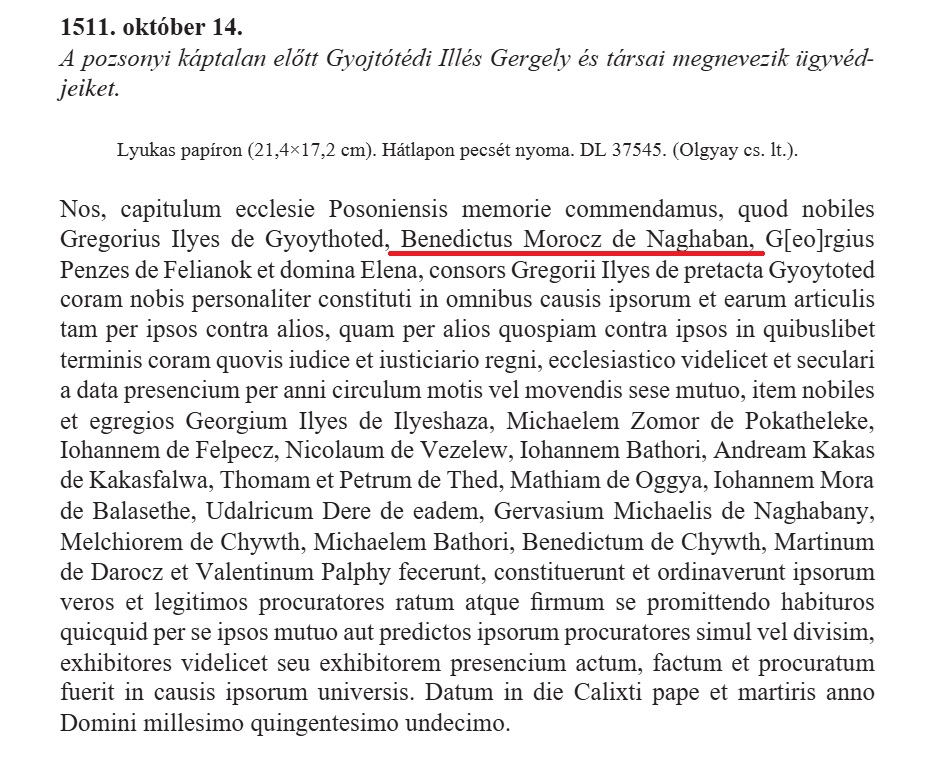 Nobilis Benedictus Morocz de Naghabany - 1511
Benedict lived at the turn of the 15th and 16th centuries, leading up to the Battle of Mohács. As a nobleman, he was actively involved in estate management and public life, as evidenced by a charter dated October 14, 1511. In this document, issued by the Pressburg Chapter, he appears under the name Benedictus Morocz de Naghaban as a confidant and legal representative of Gregory Illésházy.
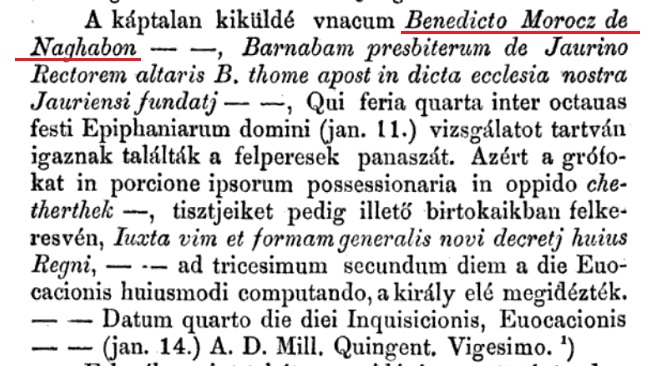 Benedicto Morocz de Naghabany - 1520
This archival snippet documents a diplomatic and legal mission from January 1520, in which Benedict Mórocz of Nagyabony (Benedicto Morocz de Naghabon) participated. The Chapter, together with the priest Barnabas of Raab, sent him to the town of Štvrtok na Ostrove (*oppido Chetherthek*) to investigate property grievances. Based on their findings, which confirmed the validity of the complaints, local counts and officials were summoned directly before the King, demonstrating the high level of authority Benedict held at that time.
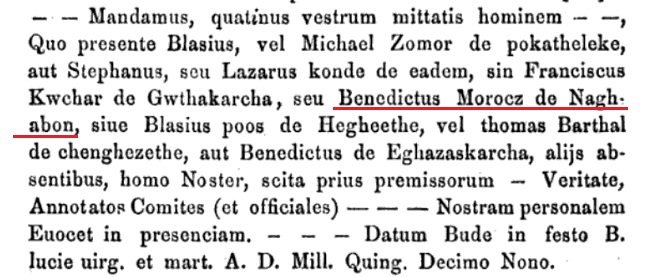 Benedicto Morocz de Naghabany - 1519
This record documents Benedict's prominent social standing. In December 1519, a royal mandate was issued in Buda, in which Benedict appears alongside the region's leading nobles during an important legal proceeding concerning the summons of county officials.
Estates and the Lost Settlement of Nadvár
Benedict was a determined landowner who sought to expand the family domain. In addition to his inherited estates in Nagyabony (Veľké Blahovo), he gradually acquired further holdings in the strategic area of Nadvár.
- In 1511, he acquired half of the property share in Nadvár from the nobleman Gervasius of Nagyabony, thereby strengthening the family's influence in this location. He owned fields, forests, meadows, noble curiae, and farmsteads not only in Nagyabony but also in adjacent localities such as Gaathzeg and the aforementioned Nadvár. In this settlement, he also obtained a share of fishing rights.
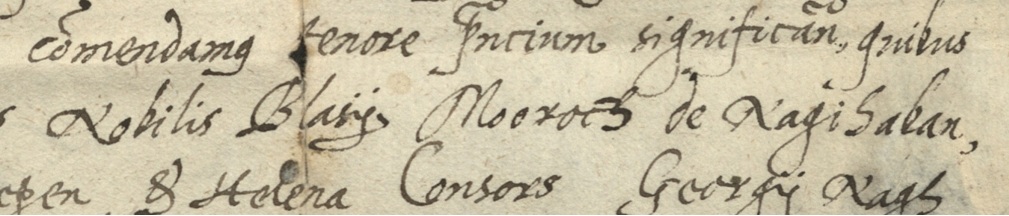 Nobilis Blasius Morocz de Naghabany - 1577
This snippet from a historical charter dated 1577 contains the Latin entry of the name of Blasius Mórocz, son of Benedict. He is listed in the text as "Nobilis Blasius Moorocz de NagiAban," confirming his noble origin and affiliation with the family seat in Nagyabony. His wife was the noble lady Sophie, daughter of the noble Francis Csöpönyi of Keozepchepen (Középcsöpöny).
At that time, Nadvár was a prosperous part of the district and an important economic hinterland. According to period records, it was the site of a "nádvár" (literally a **reed castle**), which was defended by the local nobility of Nagyabony. Its fate, however, was sealed by the unrest of the 17th century, when it was completely devastated and subsequently vanished due to destructive Ottoman incursions and anti-Habsburg uprisings.
A Conspicuous "Silence" in Archival Sources
Historical research into the family encounters a striking "silence" in archival records after 1525. The last mention of Benedict dates back to 1520 regarding a property mortgage in the Pressburg Chapter, whereas subsequent documents after 1525 only mention his sons and daughters. What happened during this interval?
As a nobilis (nobleman) from the Pressburg County, Benedict was duty-bound, under the threat of losing his property and honor, to enlist in the royal army of Louis II Jagiellon through the nobiliary levy (insurrectio). The Pressburg nobility formed the core of the defensive forces of Upper Hungary.
Given that he was already acting independently in legal matters by 1511, he would have been a man in his prime by 1526, likely an experienced soldier-gentry. Rye Island was a strategic assembly point for troops heading south. For a family from Nagyabony (Veľké Blahovo), it was almost impossible to remain apart from the general mobilization.
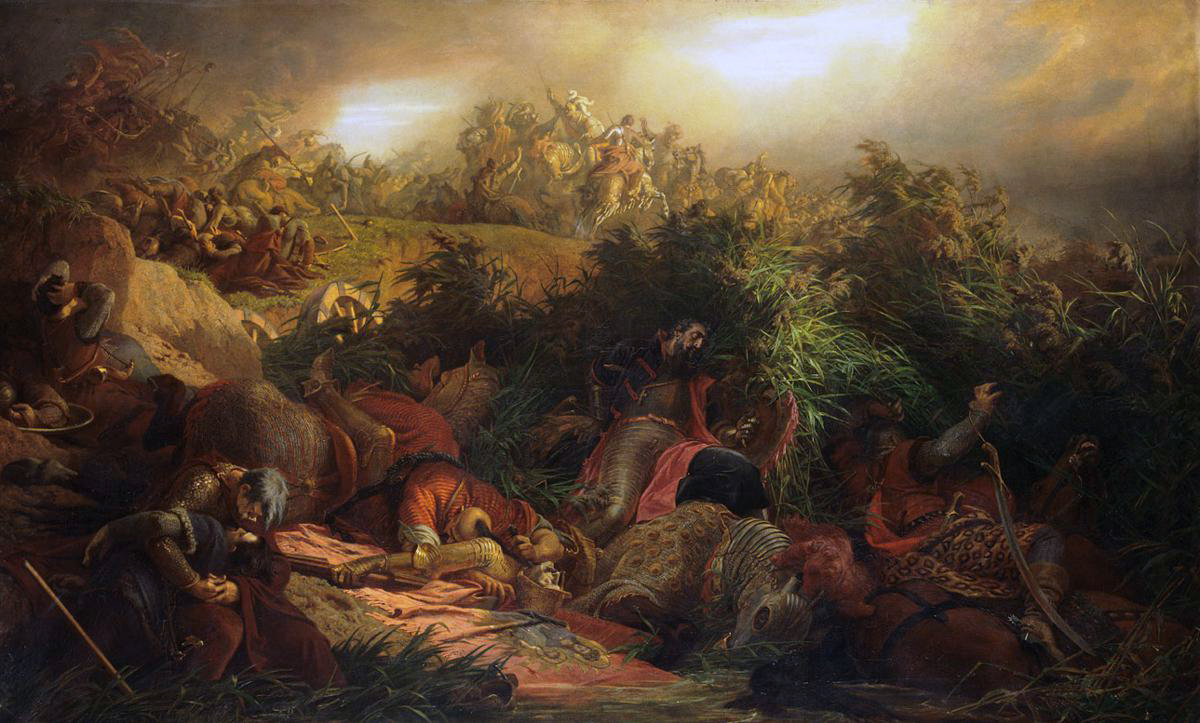 The Battle of Mohács 1526
The Battle of Mohács took place on August 29, 1526, and ended in a catastrophic defeat for the Hungarian army, led by King Louis II Jagiellon, by the Ottoman army of Sultan Suleiman I. This tragic event, in which the King himself and a large portion of the domestic nobility perished, led to the collapse of the Kingdom of Hungary and paved the way for nearly 150 years of Ottoman occupation in Central Europe.
The absence of any mention of Benedict after 1525, when the Hungarian state administration collapsed and most of the middle nobility perished, suggests that Benedict Mórocz highly likely fell or sustained a fatal injury at Mohács. This family tragedy would explain why the property and legal affairs of his children only begin to reappear in archives in bulk after the stabilization of conditions around 1530.
Although the exact years of Benedict's birth and death remain shrouded in mystery, his significance for the Mórocz family is undeniable. It was he who gave the family its name and laid the foundations of the landed holdings upon which subsequent generations of this lineage in Nagyabony built.
Inquire / Share
Would you care to share your knowledge regarding the House of Mórocz de Nagyabony, or do you have inquiries concerning this lineage? Pray, send us a message.