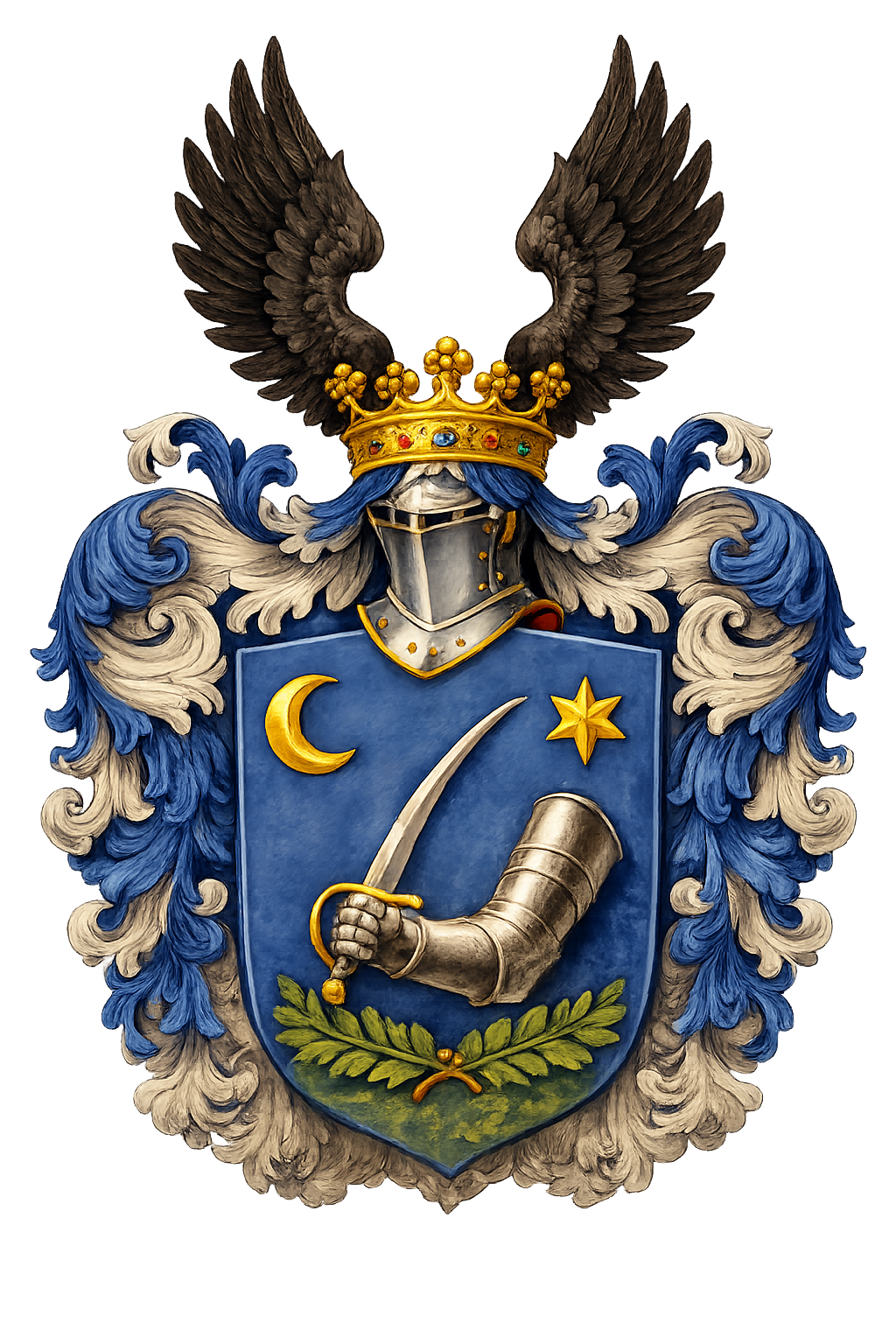
Youth and the Beginning of Military Service
András Mórocz was born in 1891 in Jahodná/Eperjes, a village in Pressburg County. He was a direct descendant of Ambróz Mórocz, the primary donee of 1641 and co-owner of Nagyabony (Veľké Blahovo). His father, Ján Mórocz, was a noble landowner from Eperjes, and his mother was Žofia Takács. He was the grandson of Anton Mórocz, whose ancient lineage and the noble title de Nagyabony were confirmed by the county authorities in 1823, along with his relatives from Jahodná. Through his mother, he was linked to the ancient Ollé de Tejed family, and his grandmother hailed from the Seregély family.
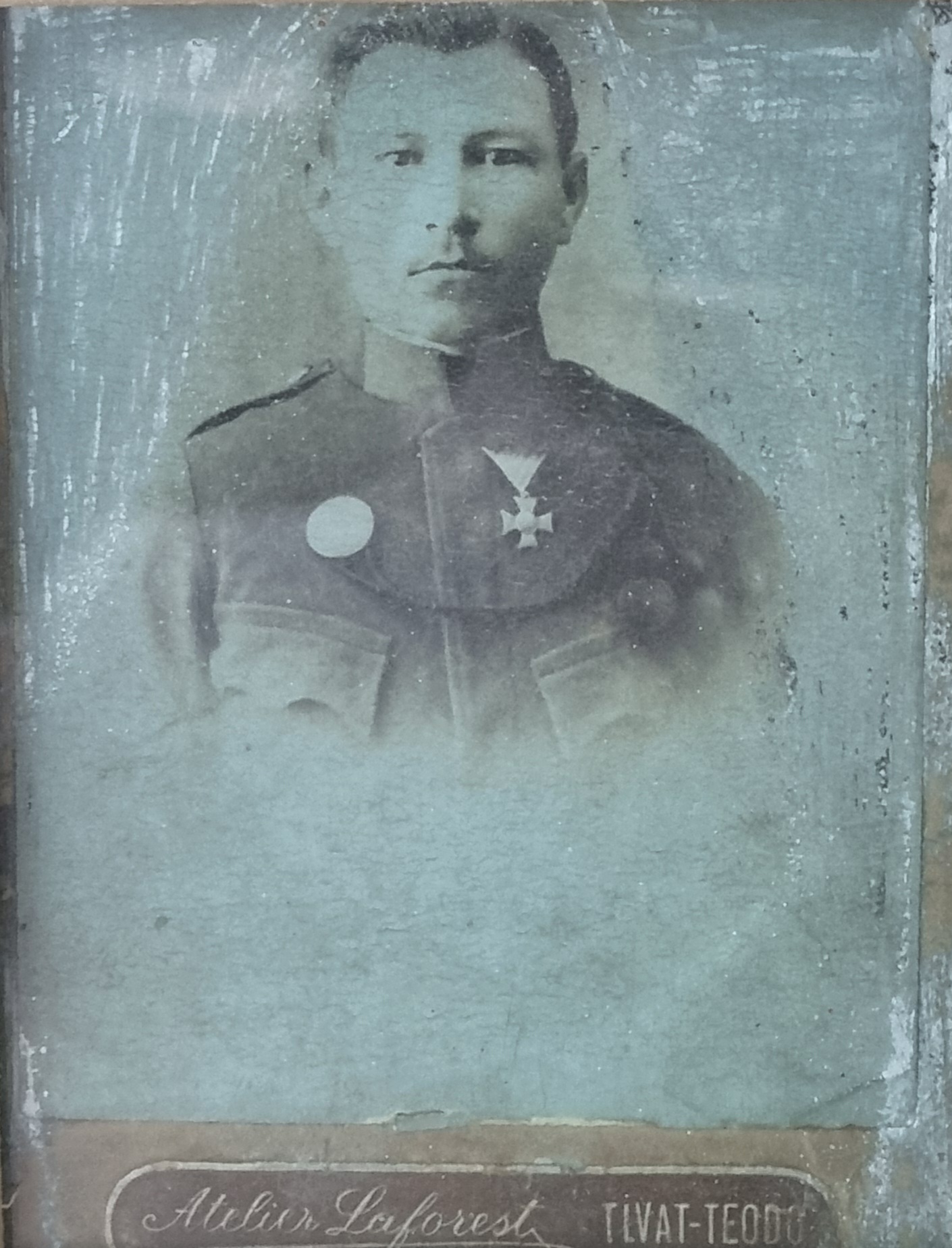 András Mórocz de Nagyabony
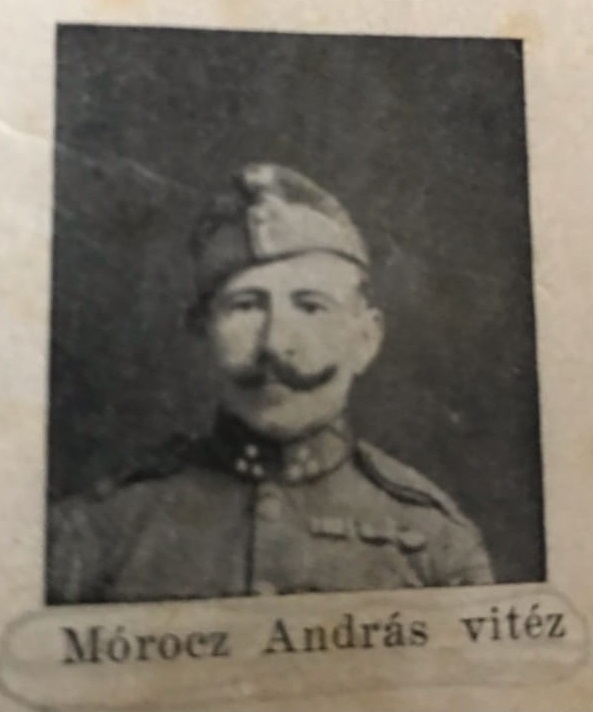
This historical portrait from 1913 captures the young nobleman András Mórocz de Nagyabony at the start of his military career. The photograph was taken at the renowned Laforest studio in Tivat (then part of Austria-Hungary), where András served along the Adriatic coast in the ranks of the 72nd Imperial and Royal Infantry Regiment. On his uniform, he proudly wears the 1912–1913 Mobilization Cross, awarded for his participation in the Balkan mobilization. The image portrays a young man on the threshold of great historical events, determined to carry on the family tradition of homeland defenders established by his ancestor, Ambróz Mórocz.
In his youth, he moved to the Horný Dvor (Felső Údvar) estate near Senec with his relatives from the Dékány family, where he would later spend most of his life. He gained his first military experience during the Balkan Mobilization of 1912–1913, for which he received the Mobilization Commemorative Cross.
In 1914, he joined the 72nd Imperial and Royal Infantry Regiment in Kotor (Cattaro). He was soon deployed to the Serbian front, where in September 1914 near Jagodina, during a fierce enemy counterattack, he distinguished himself as a squad leader by breaking through enemy lines. He was wounded in action.
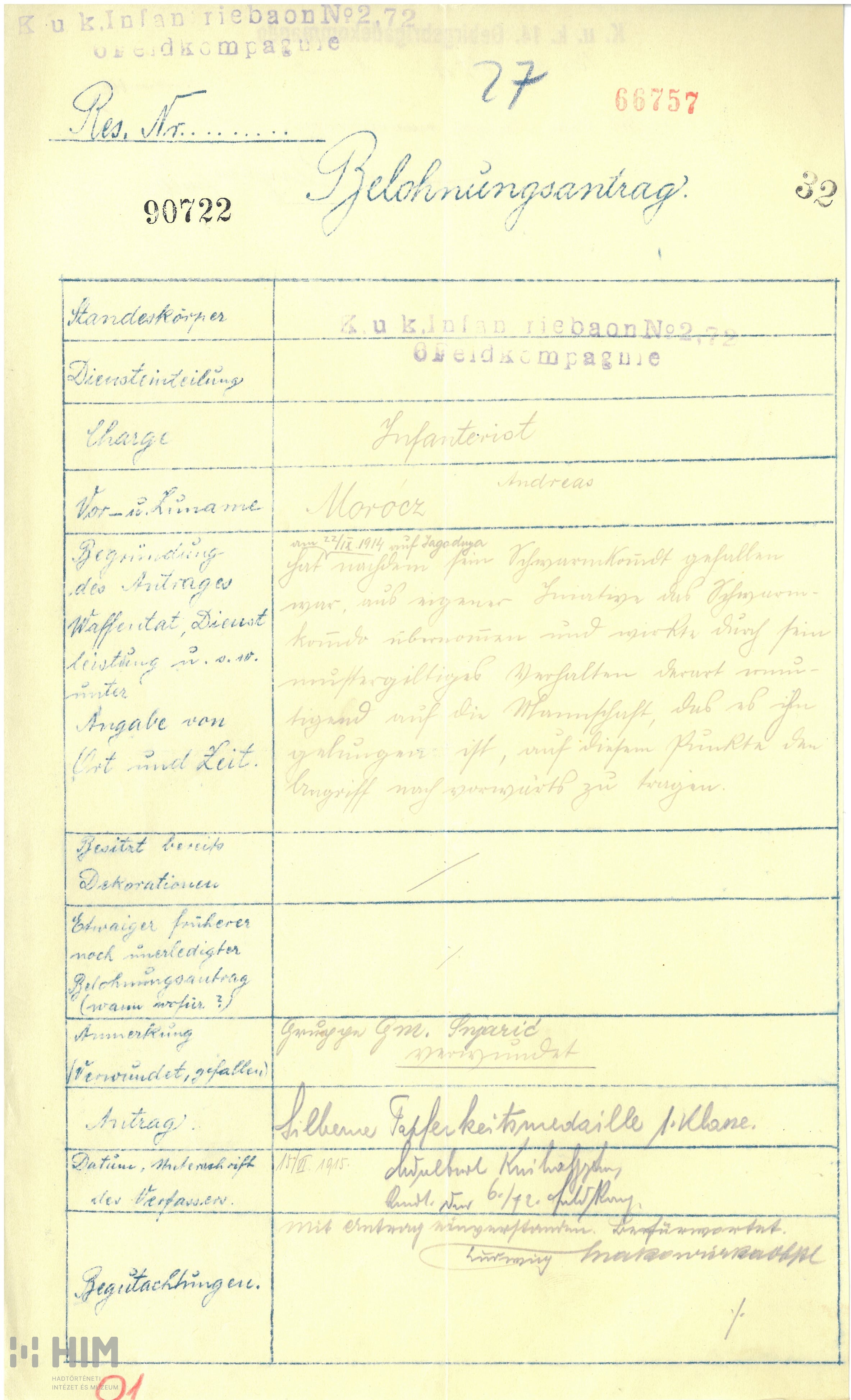 1915 - Official recommendation for decoration
A rare archival document from 1915: The official recommendation for the decoration of Andreas Mórocz. This record is direct evidence of the heroism of the nobleman from Jahodná, who took command in the front line at a critical moment near Jagodina after his commander's death. It was this "Silver Medal for Bravery, 1st Class" that later paved his way to the prestigious title of Vitéz.
After his recovery, he fought on the Italian front, where he was shot in the knee at Doberdó. In 1917, he served on the Romanian front, carrying out voluntary reconnaissance missions.
 1916 - Battle of Doberdó
The Battle of Doberdó, fought in August 1916, represents one of the most tragic chapters of the fighting on the Italian front during World War I. This strategic area in the karst mountains became the scene of the Sixth Battle of the Isonzo, where the forces of the Kingdom of Italy and Austria-Hungary faced each other. The combat was characterized by extreme brutality and took place under inhuman conditions on sharp, rocky terrain, which multiplied the effects of artillery fire as rock fragments flew through the air like shrapnel. For the Austro-Hungarian units, which included many soldiers from Slovak and Hungarian territories, Doberdó became synonymous with "stone hell." Despite the heroic resistance of the defenders, this clash ended with the retreat of Austro-Hungarian forces and the capture of the city of Gorizia by the Italian army, with both sides suffering massive casualties.
Awards and Honors
For his extraordinary merit and courage on the battlefields of the Great War, András Mórocz was decorated multiple times. Among his most significant honors is the Silver Medal for Bravery, both First and Second Class. These decorations were awarded for specific heroic acts in the face of the enemy. The First Class (Large Silver Medal) was one of the highest awards for bravery available to non-commissioned officers and enlisted men. The Second Class (Small Silver Medal) confirmed his repeated courage in dangerous combat situations.
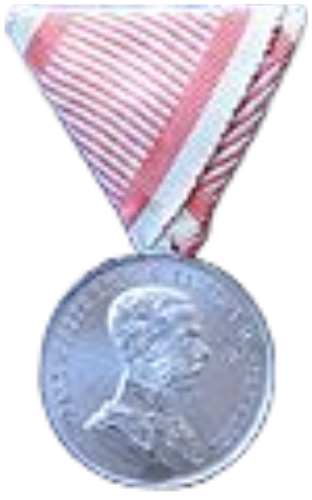 Silver 1st Cl.
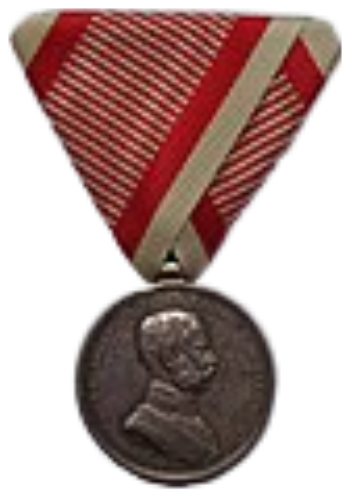 Silver 2nd Cl.
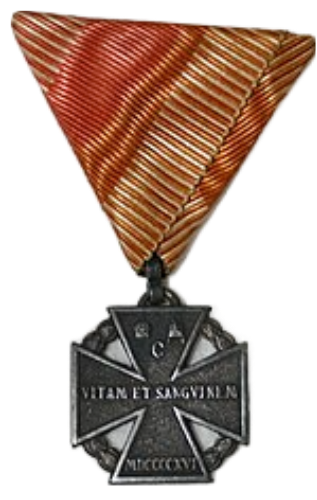 Karl Cross
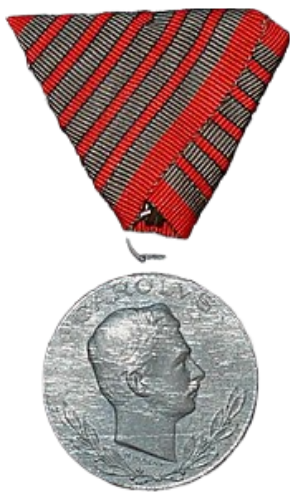 Wound Medal
 Memorial Medal
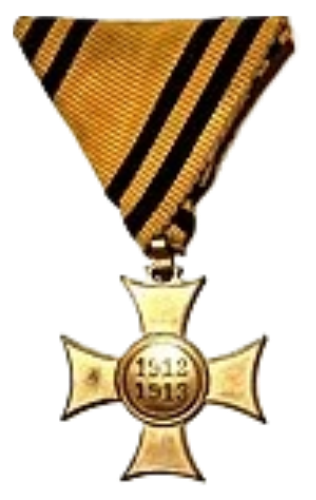 Mobilization 12/13
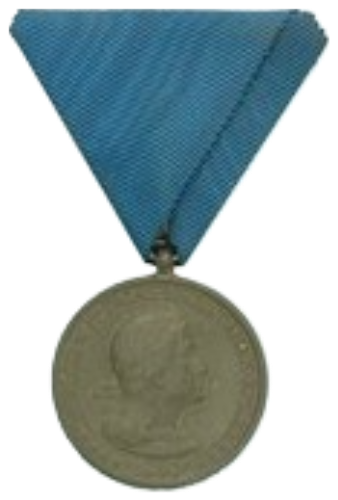 Transylvanian M.
In recognition of his faithful service on the front lines, he was awarded the Karl Troop Cross (Karl-Truppenkreuz), and for wounds sustained on the Serbian and Italian fronts, he received the Wound Medal. His military collection is completed by the 1912–1913 Mobilization Cross, the Hungarian War Memorial Medal, and the Transylvanian Memorial Medal. His exceptional military feats are also mentioned by Count József Takács-Tolvay in his work "In the Service of the Front-line Fighters" (Frontharcos eszme szolgálatában), where he highlights András's selflessness and exemplary heroism during the heavy fighting.
Family, Farming, and the Order of Vitéz
After the war, András Mórocz returned to the Horný Dvor manor (Felső Údvar) near Senec. In 1922, he married Alžbeta Görföl, from a noble family of Jelka (de Nagy-Jóka), whose lineage was linked to the ancient Tajnay de Tayna and Farkas de Nagy-Jóka families. Together they had six children and managed the family estate.
 Alžbeta Görföl de Nagy-Jóka
Alžbeta Görföl de Nagy-Jóka hailed from an ancient noble lineage deeply rooted in the village of Jelka. The Görföl family belonged to the traditional landed gentry of Pressburg County and proudly bore the "de Nagy-Jóka" title, referring to their historical seat. Alžbeta was a bearer of significant ancestral traditions, as her family was directly connected through marriage and estates to the leading noble houses of the region, such as the Tajnays of Tajna and the Farkases of Jelka. As the wife of András Mórocz, she brought not only noble grace to their life at Horný Dvor but also a strong family foundation that supported the upbringing of their six children and the management of the family farm.
In recognition of his outstanding service and heroism in the Great War, András applied for admission to the Order of Vitéz, into which he was inducted in 1938. This order was established by Regent Miklós Horthy to honor men who demonstrated exceptional courage. By 1940, as a member of the order and a platoon commander of the 1st Royal Hungarian Honvéd Hussar Regiment from Budapest, he participated in military actions connected with the restoration of Hungarian administration in Northern Transylvania.
 vitéz András Mórocz in 1940
This historical portrait depicts András Mórocz during the height of his military career, dressed in the uniform of the Royal Hungarian Hussars. The name "Mórocz András vitéz" below the portrait, with the title following the surname, clearly confirms his social and knightly status earned through battlefield bravery. Three stars are visible on his collar, denoting the rank of platoon commander (sergeant), while his military appearance is completed by the characteristic field cap. His heroism is evidenced by the visible medal ribbons on his left chest. The overall impression of military pride and belonging to the elite cavalry is underscored by his upward-curled mustache, an essential symbol of prestige for every hussar of that era.
In 1940, András Mórocz took part in the military operation associated with the reunification of Northern Transylvania with Hungary based on the Second Vienna Award. In this campaign, he served as a platoon commander in the elite 1st Royal Hungarian Honvéd Hussar Regiment based in Budapest. This regiment was a direct bearer of glorious cavalry traditions and served as a mobile vanguard, securing strategic points and performing reconnaissance.
The entry of hussar units into Transylvanian towns was seen as a powerful symbolic act and represented the culmination of efforts to rectify the post-war border settlements. For his exemplary service during this operation, András Mórocz was decorated with the Transylvanian Memorial Medal (Erdélyi Emlékérem). This experience in the ranks of the royal hussars definitively sealed his standing as a seasoned military leader and dedicated patriot.
Post-war Fate and Legacy
Following the arrival of Soviet power, the Horný Dvor manor was confiscated and collectivized. András Mórocz was forced to leave the estate and spent the remainder of his life in Senec, where he passed away in 1958. His wife, Alžbeta, survived him by many years, passing away in 1992 at the age of 88.
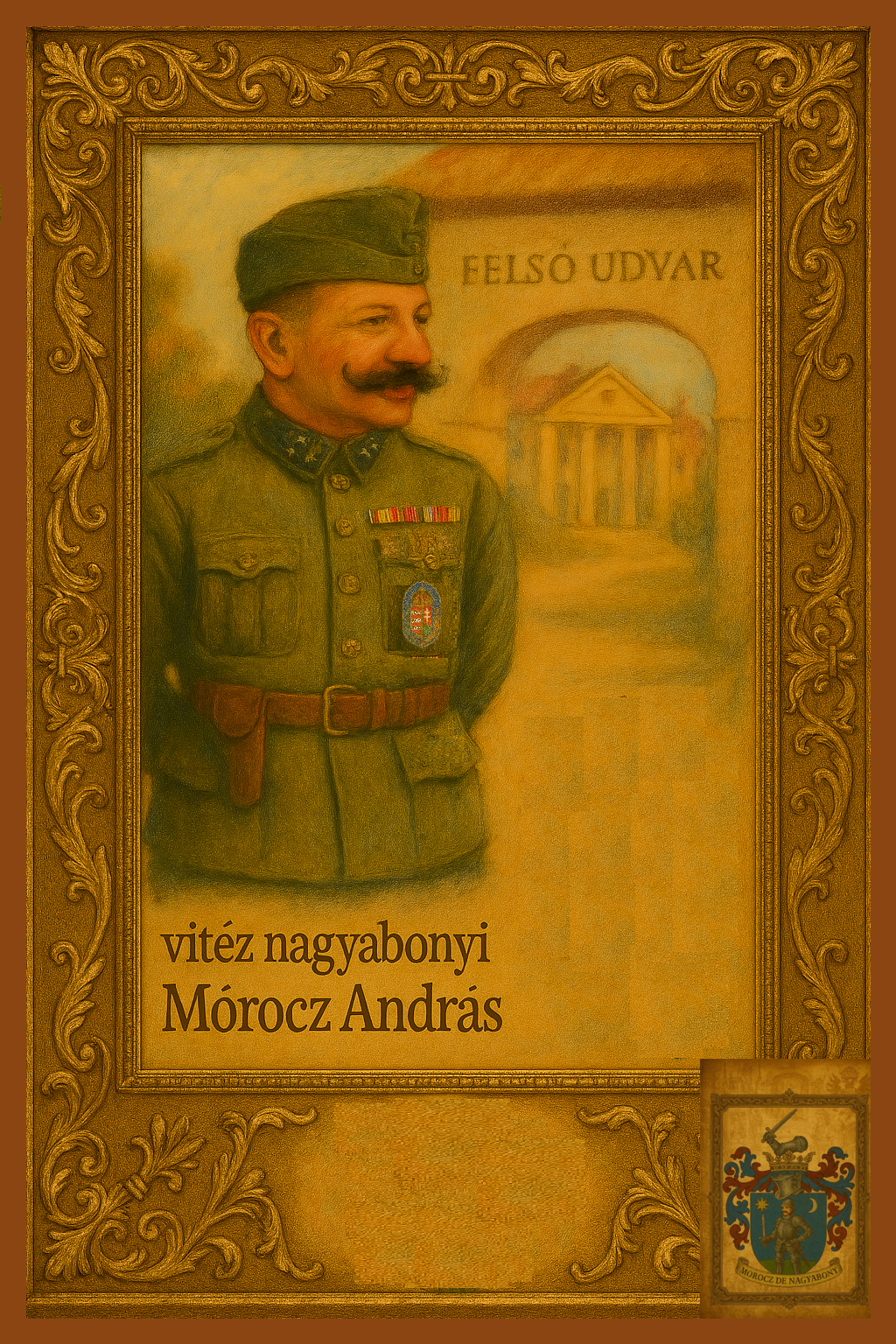 vitéz András Mórocz de Nagyabony
Portrait of vitéz András Mórocz de Nagyabony, circa 1940.
Today, the successor of the family tradition is his great-grandson, Róbert Mórocz, who in 2022 was dubbed a hereditary knight of the Order of Vitéz in Máriapócs, Hungary, by Archduke Joseph Karl von Habsburg-Lothringen. This act symbolically restored the ancestral honor and continuity that András embodied throughout his turbulent life.
András Mórocz de Nagyabony was the last great bearer of the military courage of the ancient Žitný ostrov (Schüttinsel) lineage. In his actions, he embodied the deep roots of his ancestors, who defended the homeland for centuries. As a direct descendant of Ambróz Mórocz, he carried forward the historical legacy of a family that had protected the land since medieval times. His life remains an important reminder of our region's history and the noble traditions that endured despite the adversity of fate.
Inquire / Share
Would you care to share your knowledge regarding the House of Mórocz de Nagyabony, or do you have inquiries concerning this lineage? Pray, send us a message.