Pillar of Power: Nobiles Possessionati
The Mórocz family belonged to the ancient landed middle nobility. Their roots, reaching back well before 1526 (the Battle of Mohács), established them as original landowners, earning them profound respect within the Pressburg County. In county official records, the Mórocz family of Nagyabony was documented as ancestral deep-rooted nobility.
 1823 - Törzsgyökeres Nemesek - Mórocz de Nagyabony
Excerpt from a statement by the county office in 1823. The phrase "Törzsgyökeres Nemesek" (Deep-rooted Nobles) in such a charter served as irrefutable proof during nobility verification processes (*investigatio nobilitatis*). The office thereby confirmed that the family owned land and manorial estates based on ancient law, from time immemorial. Only "rooted" nobility could hold the highest offices in the Pressburg County (e.g., County Magistrate – *iudex nobilium*). With this declaration, the office confirmed that the Mórocz family held the full right to manage the public affairs of the region. For the society of that time, this meant that the Móroczs were not merely titleholders, but an integral part of the country's social fabric. It was a confirmation of their authenticity and prestige, ranking them above the "new" nobility who often acquired titles only through service or purchase.
This status signified that they were not "immigrant" nobility or mere titleholders without land, but a family firmly intertwined with the local territory and its history. As curial nobility, they directly managed their noble manors (curiae) and, as "masters of their own," they formed the authentic social elite and the power base of the Rye Island region.
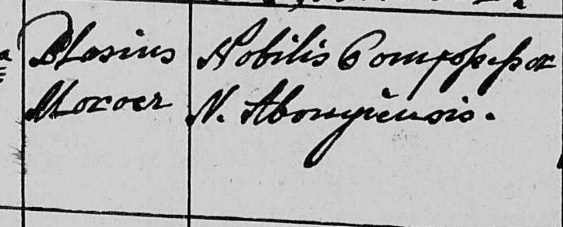 1827 - Blasius Morocz de Nagyabony
The entry "Blasius Morocz, Nobilis Compossessor N. Abonyiensis" confirms that Blasius was a middle-ranking nobleman and a co-possessor of the family estates in Nagyabony, directly fulfilling the legacy of his ancestors as a respected lord of the land.
Strategic Loyalty and Influence on Rye Island
The strength of the lineage lay in political intelligence and the ability to maintain the favor of sovereigns. Alongside families such as the Csiba, Csomor, Szelle, Kázmér, Dobos, Posa, Gyárfás, Brissel, and Bőke, they formed a powerful noble bloc (intermarried and allied) that controlled the Rye Island region. They were confident landowners who knew how to effectively combine ancient medieval claims with the modern law of their time under the protection of the Imperial Crown.
 1771 - Emericus Morocz de Nagyabony
Emericus is titled in the record as H. ac N. (*Honestus ac Nobilis*), confirming his status as an honorable and noble gentleman of Nagyabony. This title, along with the designation *Juvenis*, defines him as a young unmarried nobleman continuing to maintain the family prestige earned by his forefathers.
Dawn on the Rye Island: From Guests to Guardians (12th – 13th Century)
The origins of the lineage date back to the 12th century, when King Stephen III settled the so-called "Bohemian guests" (hospites) in the strategic settlement of Abony. These free men arrived with a military mission to protect the integrity of the Hungarian frontier and were granted lands in the Abony (Nagyabony) area with the freedom of their own discretion. At their own request, they became Royal Courtiers. Their privileges were confirmed by Andrew II and later in 1236 by Béla IV.
Historical charters from this period list the first names of the Abony clan: Csiba, Ibur, Heym, Sid, Pocus, Karácson, Illezus, Sath, Hugel, Nolch, Ján, Kelemen, Stegun, and Amadé (Omodias). These free warriors laid the foundation for the later transition into the estate of the landed nobility.
 Hungarian Nobleman
1299: A Turning Point in Battle and Charter
The final breakthrough was brought by valor on the battlefield. In 1298, at the Battle of Göllheim, John (János) of Abony distinguished himself exceptionally, fighting by royal command under Count Dömö. For his bravery, King Andrew III elevated him in 1299 to the status of the nobility of the realm (nobiles regni).
This act extended to the entire group of kinsmen: John, Csiba, Jaka, Marcel, Matthew, Bug, Andrew, and Musga. Later, King Louis the Great exempted the entire village from castle service, giving rise to a noble curial settlement. From this common root, the ancient houses of Nagyabony emerged: Mórocz, Csiba, Csomor, Szelle, Gyárfás, Kazmér, and Végh.
Evolution of the Surname and Stabilization of the Lineage
The transition to a firm dynastic identity is demonstrated by the development of the name starting from the first documented ancestor, Michael de Nagyabony. His son, Mauritius (Móric) de Nagyabony (1488), provided the linguistic root for the surname Mórocz. The name was first consistently used by Benedikt Mórocz de Nagyabony (mentioned in 1511 and 1518), who secured the family's standing through his marriage to Katarína Zempczy of Báčfalva.
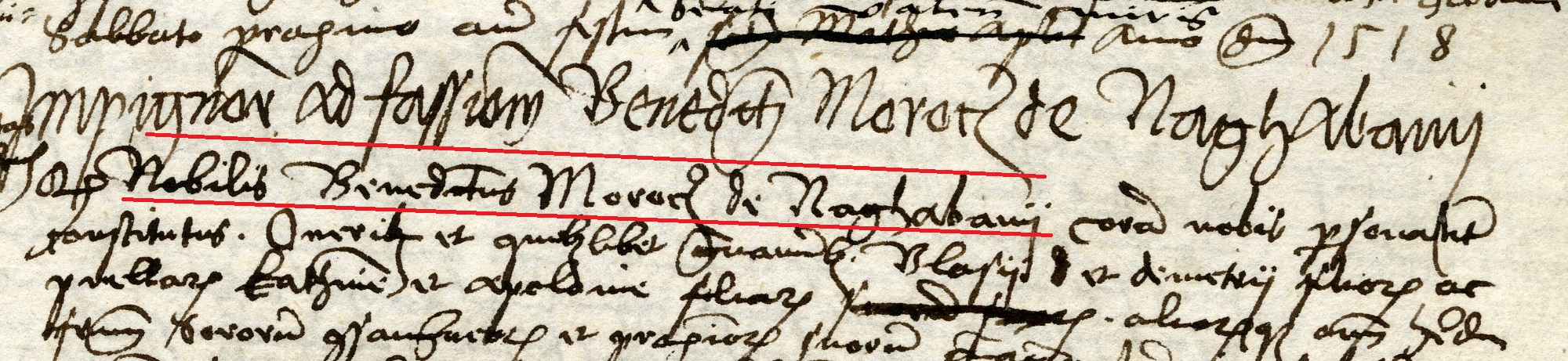 1518 - Benedictus Morocz de Naghabany
This rare record from the Pressburg Chapter dating to 1518 serves as key evidence of the antiquity of the Mórocz de Nagyabony lineage. The charter confirms that the family held estates in Nagyabony already in the pre-Mohács era and fully employed their noble predicate.
The Latin text explicitly states the name Benedictus Morocz de Nagyabony, documenting the continuity of noble status and land ownership on the Rye Island as early as the beginning of the 16th century.
Landed Estate and Social Influence
Benedikt, father to sons Blasius and Demeter, owned estates in Nagyabony and acquired shares in the village of Nádvár. However, during the 17th century, this settlement faced the devastating consequences of the Ottoman expansion—during the Turkish raids, Nádvár was definitively plundered and destroyed. Benedikt’s prestige is further evidenced by his role as an envoy of the Pressburg Chapter, where in 1520 he mediated disputes among the nobility.
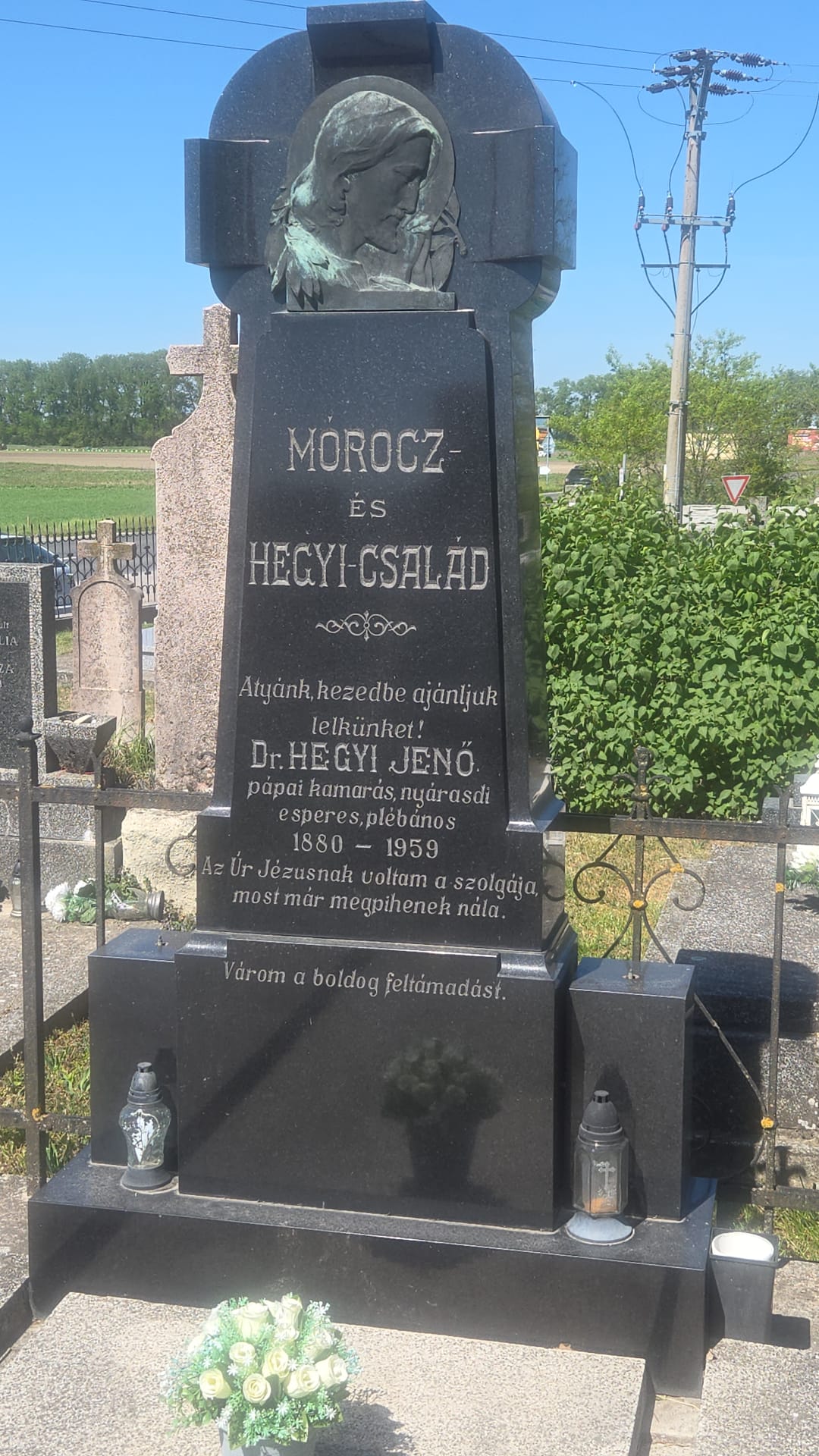 Monumental tombstone in Veľké Blahovo
The photograph depicts the monumental tombstone of the Mórocz de Nagyabony and Hegyi de Hodos families, located in the cemetery of Veľké Blahovo. Situated at the highest point of the cemetery, the monument naturally dominates its surroundings, emphasizing the historical significance of the buried lineages. It features a tall pylon made of polished black granite, with an artistic relief of the suffering Jesus Christ with a crown of thorns set in its upper section. The entire monument is topped in the shape of a cross, highlighting its sacred character. The main inscription is dedicated to the memory of Dr. Jenő Hegyi (1880–1959), a prominent ecclesiastical dignitary. The Hungarian text lists his titles – Papal Chamberlain, Dean, and Parish Priest of Topoľníky (Nyárasd).
The 1641 Grant: The "Small Republic" of Nagyabony
On June 4, 1641, King Ferdinand III issued a Royal Grant to Ambrosius (Ambrusius) Mórocz, which codified a unique system of self-governance – the compossessorate. Nagyabony became, in effect, an independent "small republic," where ten kindred families exercised collective manorial lordship.
This autonomy rested on three pillars: collective land management (joint decision-making regarding forests and fields), full judicial power over subjects, and administrative sovereignty, which ensured independence from surrounding magnate estates.
Four main donor lines descend from the sons of Ambrosius – namely John, Paul, Luke, and Thomas. Ambrosius also had sons named Baláž and Gregory, who presumably died without issue.
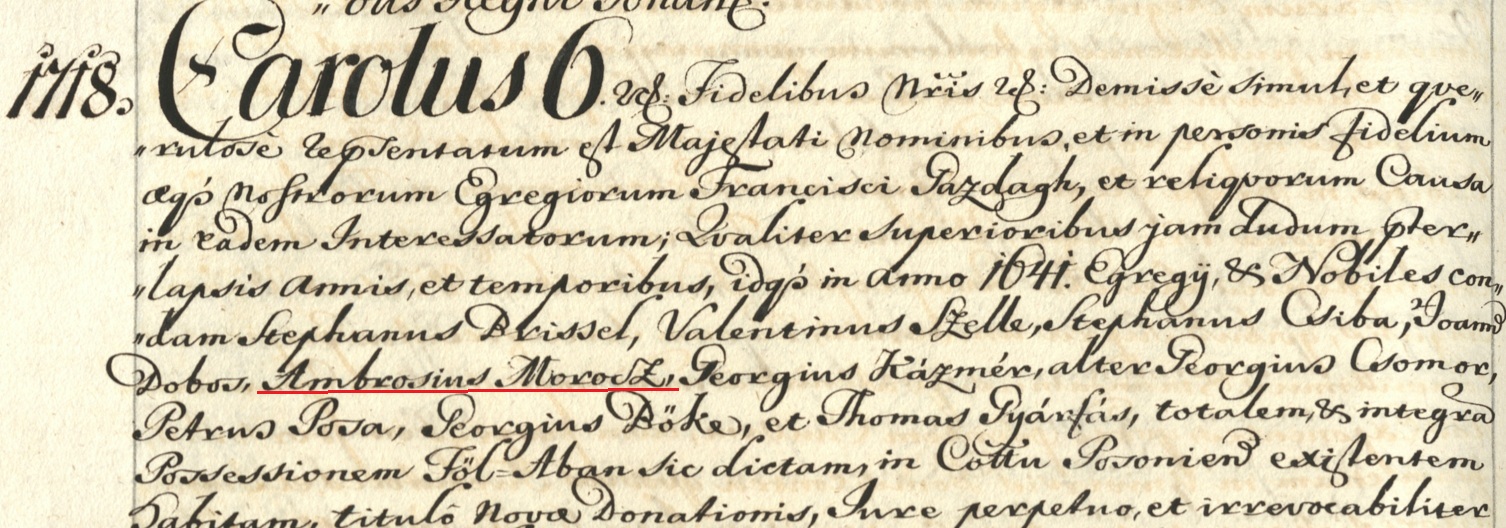 Part of the 1718 record - Letters of Protection for the 1641 Grant
The significance of the lineage was later reaffirmed by the Letters of Protection of Charles III (1718), which guaranteed the sovereignty of the house and shielded their granted estates from the territorial ambitions of surrounding magnates, such as the Esterházy and Pálffy families.
Alongside the donor branch of Ambrosius, the branch of Michael (1649) emerged, which was not part of the original grant.
Letters of Protection (1718): King Charles III issued a document confirming the validity of the grant, protecting the lineage from attacks by the rival Csiba family and from the influence of powerful houses such as the Esterházys and Pálffys.
In the 17th century, Ambrosius Mórocz served as a pivotal pillar of dynastic stability and a strategic architect of the noble presence in Nagyabony.
Social Status: Elite of the Rye Island
In official records, he is documented with the titles Egregius et Nobilis. As a member of the respected landed gentry, he enjoyed personal freedom and was directly subordinate only to the King, while holding an important military office in the defense of the Rye Island.
Architect of the Ancestral Estate: Collective Grant (1641)
The year 1641 marked the zenith of his efforts when he obtained a New Grant (Nova Donatio) and confirmation of ancient estates from King Ferdinand III. This was not an individual gift, but a collective ownership (compossessoratus), which Ambrosius secured in recognition of his faithful services (fidelia servitia).
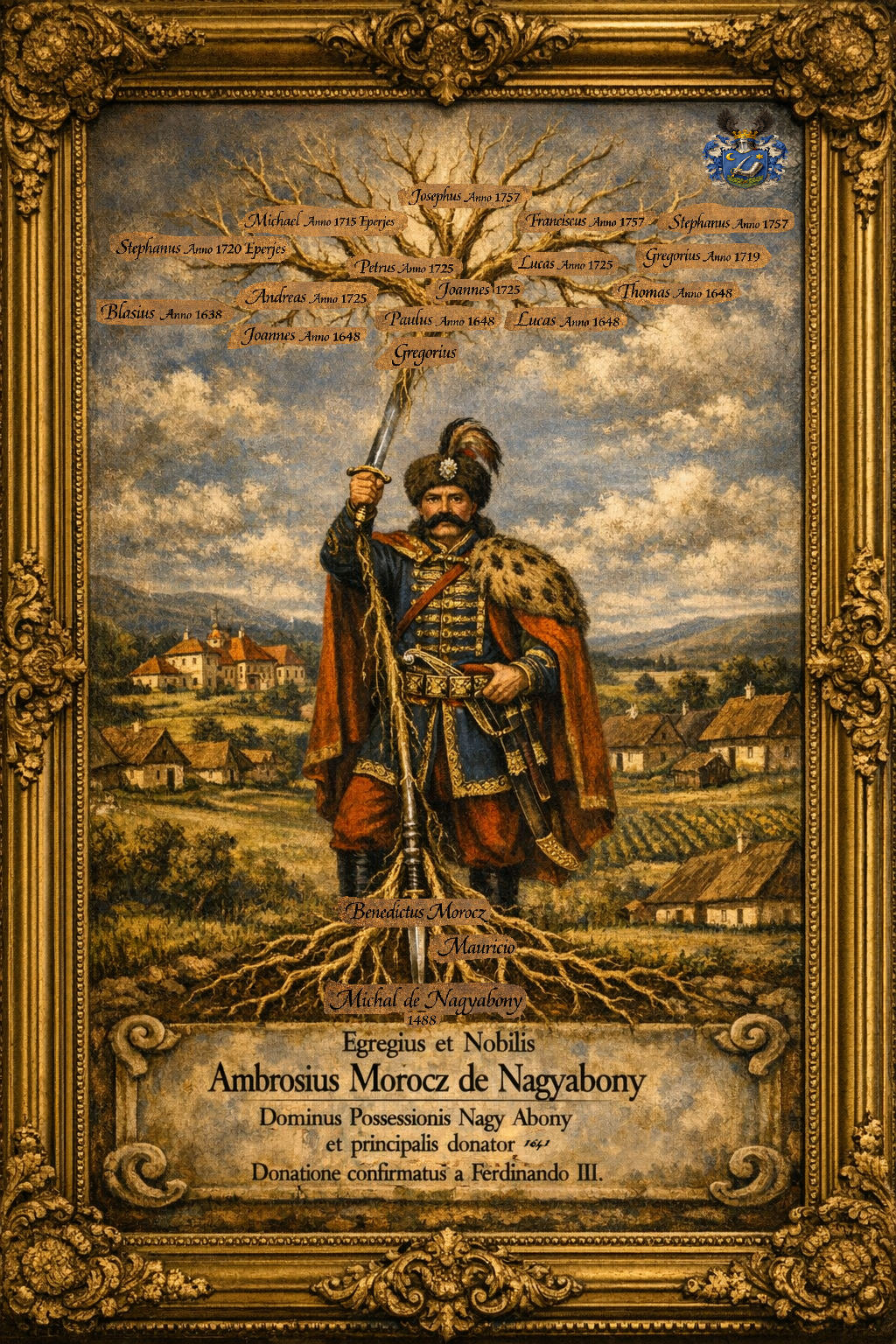 Pedigree of the immediate family of Ambrosius
The pedigree of Ambrosius’s immediate family, including his sons, grandsons, and great-grandsons, represents the key line of continuity for the House of Mórocz in Nagyabony, established on the legal foundation of the 1641 Royal Grant.
Extent of the Lordship: Complete Economic Foundation
Within his ancestral share (Portionem), he owned a noble manor (curia), arable land, meadows, and strategic forests. His estate also included subject families, over whom he exercised judicial authority.
Victorious Defender in Court (1650)
In 1650, he successfully defended the family estates against challengers (Contradictores) at the court in Pressburg. With this victory, he definitively secured the inheritance legally for male descendants only (pro sexu masculino).
Immortal Name and Royal Shield (1718)
The foresight of Ambrosius served his grandsons as an impenetrable shield of protection even decades after his passing. In 1718, King Charles III reaffirmed the stability of the Mórocz lineage and the protection of their ancestral lands.
The history of Nagyabony is inextricably linked to Nádvár Castle, a key bastion within the broader Frontier Fortress System known as Végvár. This strategic network of fortifications served as the first line of defense against Ottoman expansion. The village was directly integrated into this military mechanism, necessitating constant combat readiness.
It was for their distinguished service within the Végvár system and their proven knightly reliability in defending Nádvár Castle—which was destroyed during the conflicts—that the village was granted the symbol of an armoured arm wielding a sword for its coat of arms. This motif directly references the heroism of the local nobility in the 17th century.
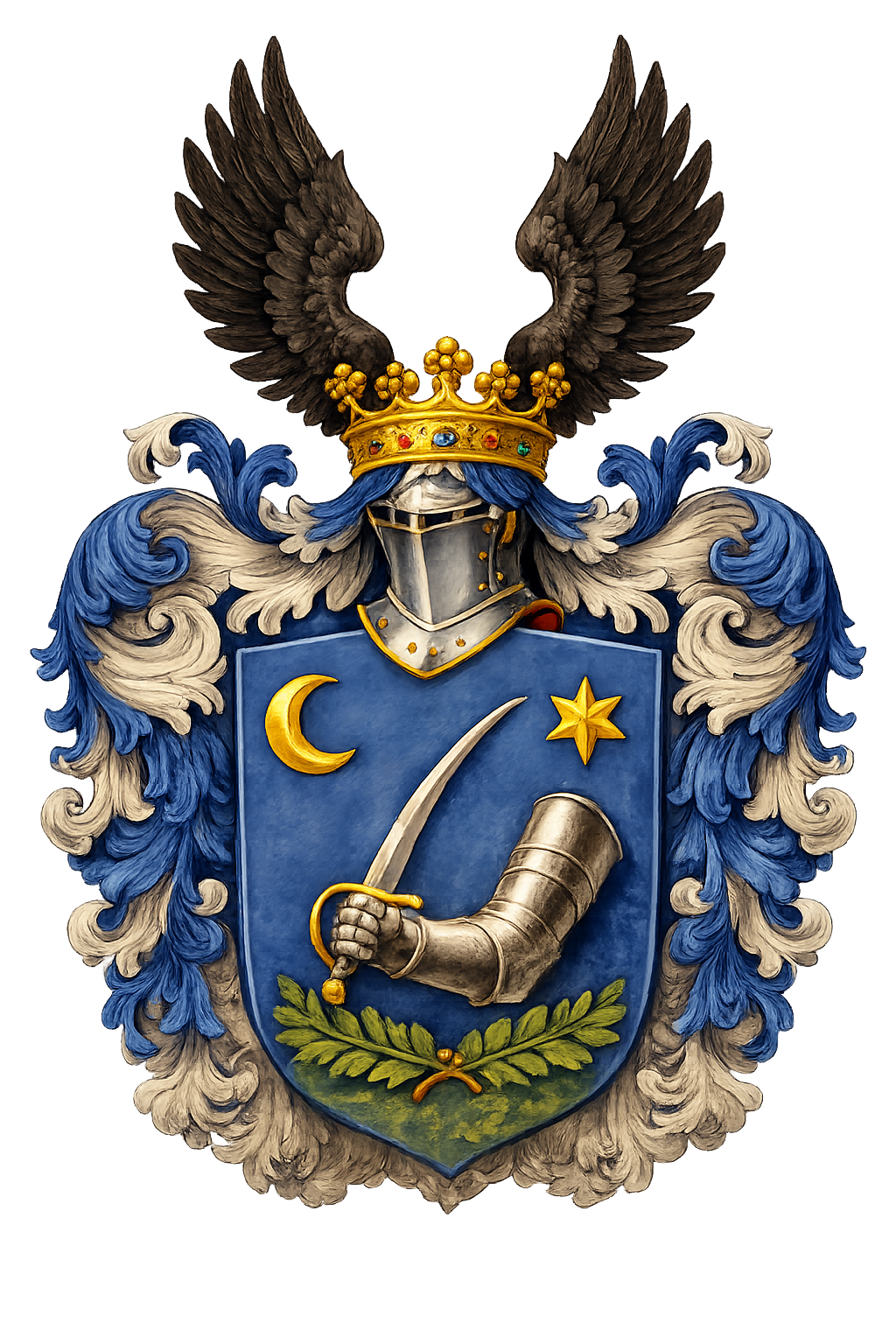
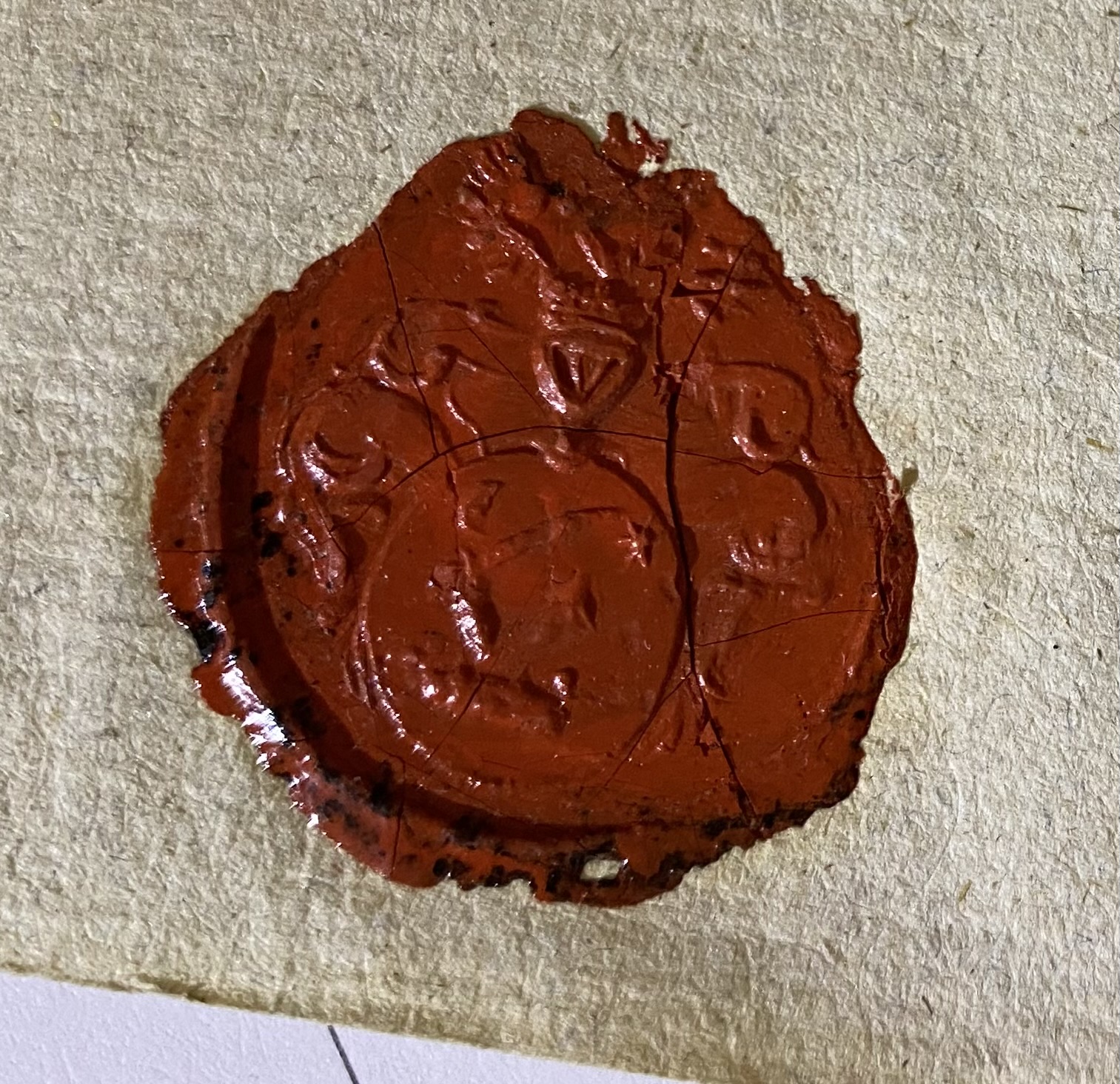 Armorial seal of the House of Mórocz de Nagyabony, 1823
The heraldry of the village of Nagyabony is closely intertwined with the history of the local nobility and directly recalls the coat of arms of the Mórocz de Nagyabony family. While the municipal emblem draws from the family's heroism during the defense of Nádvár, the noble family crest carries a more complex symbolism reflecting its elite status in the 17th century.
While the village crest depicts an armoured arm with a sword, the Mórocz family coat of arms is further enriched with a star and a crescent moon, which in heraldry symbolize eternal glory and perpetual vigilance. Above the shield rests a noble helmet with a golden coronet, from which majestic eagle wings emerge. These wings, together with the armed arm and sword, highlight the knightly reliability for which Ambrosius received the Royal Grant in 1641.
Ambrosius Mórocz, as one of the prominent landowners of Abony, embodied this military elite. His active participation in the defense of this territory within the Végvár system was the primary reason why King Ferdinand III granted him the New Donation (Nova Donatio) and confirmation of ancient estates in 1641. These properties were confirmed as a direct reward for protecting the strategic frontier.
The symbolism of the crest, where the sword is complemented by a branch, reflects the dual nature of noble life: the branch symbolizes diligent labor in the marshy lands, while the sword serves as a reminder of the duty to defend the frontier fortresses. Thus, in 1641, Ambrosius Mórocz legally anchored the legacy fought for amidst the ruins of Nádvár.
Gregor Mórocz: Head of the House and Guardian of Continuity
In September 1719, Gregor Mórocz (recorded in documents as Georgius), the grandson of Ambrosius, emerged as a key representative of the family. In the charter, King Charles III confirmed his noble status as Nobilis and commended his steadfast loyalty. Gregor succeeded in bridging three centuries of family history—stretching from the pre-Mohács roots of Benedikt, through the grant of his grandfather Ambrosius, to his own generation.
Legal Safeguard and the New Donation
Although the family had long held the estates in Nádvár and Tomogy, Gregor strategically petitioned for a New Donation (Nova Donatio). By this act, he definitively secured the property for his sons, Francis and Stephen. This 1719 document became, 40 years later in 1757, the primary evidence in a successful lawsuit regarding ancestral rights.
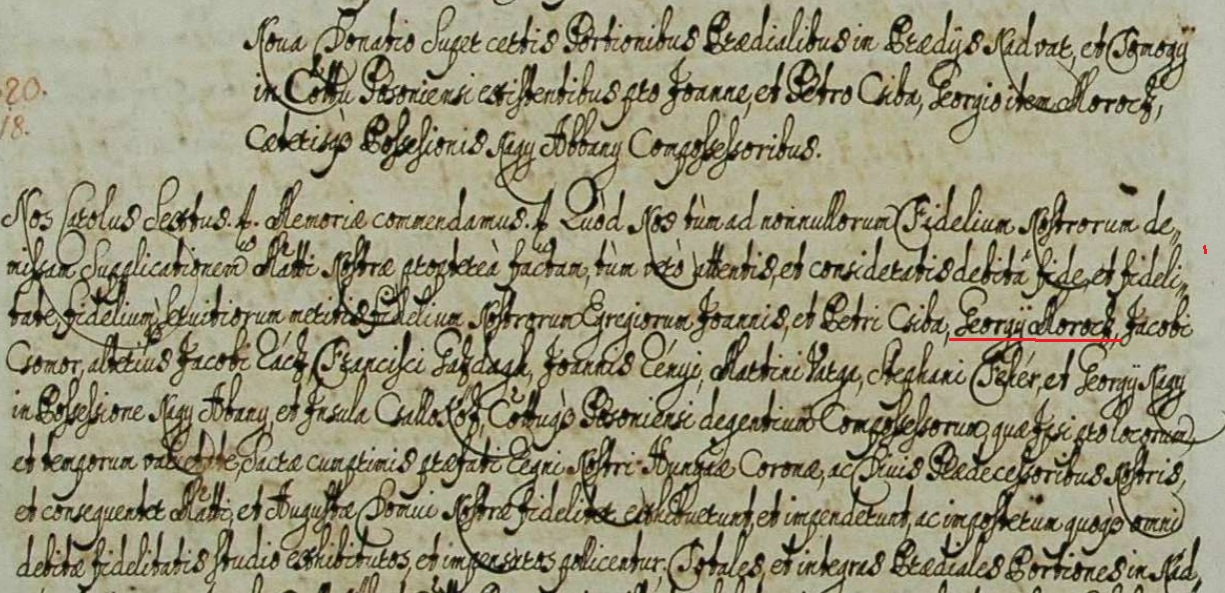 Part of the 1718 record - Collective grant for the year 1719
This 1719 document represents a collective donation (Nova Donatio), which served not to acquire new territories, but as an official confirmation of the family's historical estates. Through it, Gregor legally anchored the claims of all co-owners and definitively placed the ancient holdings of Nádvár and Tomogy under the direct protection of the Crown.
Lord of Nádvár and Economic Foundation
Gregor confirmed ownership over the complete lordship, which included arable land, meadows, pastures, and forests. His share also included subject families, and the charter guaranteed the transfer of this property exclusively to male heirs in perpetuity. In doing so, Gregor "ordered" the family archives and ensured the stability of the Mórocz name.
Analysis of historical documents clearly confirms that the standing of the Mórocz family in Nagyabony was not accidental, but the result of strategic political loyalty toward the House of Habsburg. During the turbulent 17th and 18th centuries, maintaining privileges required unwavering devotion to the Court of Vienna.
The rise and stability of the lineage are direct evidence of the policy "debita fide et fidelitate." While others risked their estates in rebellion, the Mórocz family staked their future on stability, which brought them Royal Grants. A significant confirmation was the Letter of Protection of 1718, through which King Charles III shielded the family from attacks by the rival Csiba branch and other magnate houses.
The fundamental pillar of their power, however, was the Grant of 1641, which established a unique "small republic" with full judicial authority. This status was later solidified in 1719 by Gregor (recorded as Georgius), who obtained a New Grant from the King. Through this brilliant maneuver, he linked the medieval claims of Benedikt with the modern era, securing continuity of ownership for all time.
 Ferdinand III, Holy Roman Emperor
Ferdinand III (* 13 July 1608, Graz – † 2 April 1657, Vienna) was Archduke of Austria, King of Hungary (from 1625), King of Bohemia (from 1627), and Holy Roman Emperor (from 1637) from the House of Habsburg. In 1641, he established a collective manorial lordship in Nagyabony, legally organizing the fragmented medieval holdings of the original clans into a unified and autonomous entity.
Loyalty to the Habsburgs served the Mórocz family as their greatest protective shield. Their sovereignty in Nádvár and Tomogy survived only because they were perceived as "the King’s men." This historical line of devotion and protection of ancestral heritage has not vanished within the archives.
Today, this tradition and loyalty to ancestral roots are actively continued by Robert Mórocz, who, as the guardian of family history, keeps the legacy of the "small republic" alive. As a member of the Order of Vitéz under the leadership of the Habsburg-Lorraine dynasty, he continues to fulfill his loyalty to the former reigning house and upholds the honor of his name.
Collective Testimony for the Eperjes (Jahodná) Branch
The document from 1823 serves as fundamental evidence of the presence of a significant part of the Mórocz lineage in the village of Jahodná. The signatories officially confirm that all named descendants are currently residents of Jahodná (mostanság Eperjesen lakosok), thus localizing these family branches in their new seat outside the original ancestral home.
Confirmation of the Noble Predicate "de Nagyabony"
The extraordinary significance of this testimony lies in the official confirmation for the entire Jahodná branch of the right to use the noble predicate de Nagyabony (of Nagyabony). This legal act declared that although the family resided in Jahodná, its noble identity remained inseparably linked to the mother seat and the historical grants acquired by their ancestors.
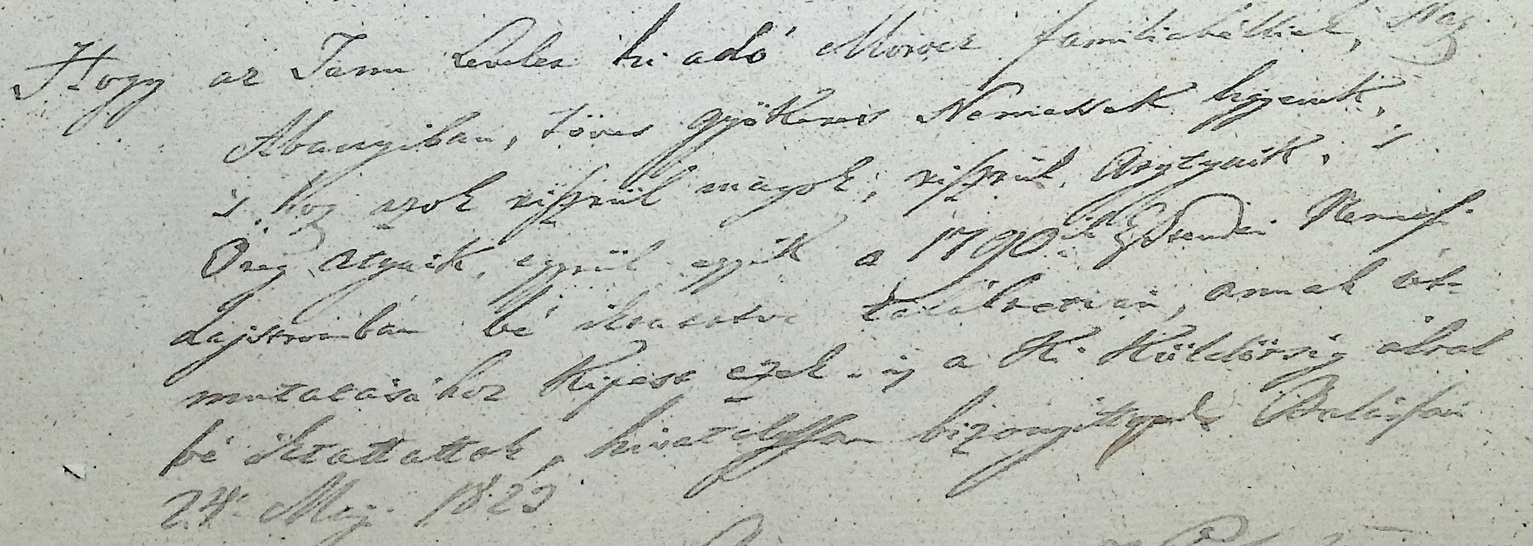 Extract from the 1823 Record of Investigation
The County Office hereby confirms and verifies the family testimony submitted by members of the Mórocz family. Based on the official investigation, we conclude that the named individuals are ancient rooted nobles (tős gyökeres Nemesek) with historical holdings in Nagyabony. The status of ancient rooted nobility confirms their standing as the regional elite of the Rye Island, enjoying the highest degree of social recognition. The Office recognizes this declaration as authentic and consistent with the actual state of ancestral continuity.
Tős-gyökeres Nemesek: Ancient Rooted Nobility
The charter defines the family in Jahodná as ancient rooted nobility. It emphasizes that their status is not a new ennoblement but stems from deep ancestral roots confirmed in the noble census of 1790. For the community in Jahodná, this meant that the Mórocz family were recognized lords with an unquestionable history.
Unity of Cousins and Common Ancestors
The document confirms the blood kinship of three groups of cousins, recognized in Jahodná as grandsons of the common ancestors Stephen and Michael:
• Stephen, son of Stephen.
• John, Francis, and Anton, sons of John.
• Francis, Ignatius, and Michael, sons of Francis.
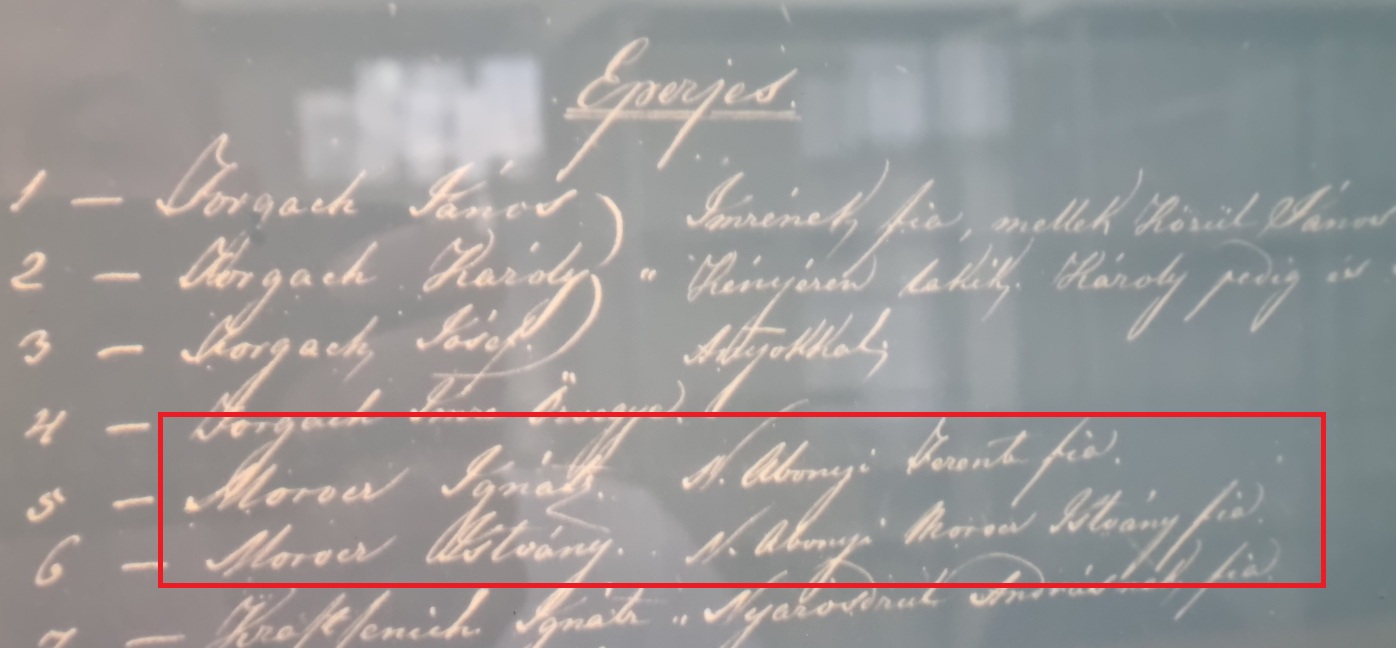 Extract from the 1823 Noble Census
The 1823 census of nobility in Jahodná (Eperjes), in which members of the Mórocz family are recorded with the noble predicate N. Abonyi (of Nagyabony). The document lists them under the heading of Eperjes, officially verifying the relocation of these branches of the ancient nobility to their new seat while preserving their original ancestral rights.
Legal Protection by the Royal Commission
The testimony was issued for the requirements of the Royal Commission to confirm the legitimacy of the Jahodná branch. Members of the lineage from Nagyabony guaranteed through their testimony that all these descendants enjoy full noble rights, the predicate, and the protection ensured for the house by earlier royal grants.
András Mórocz de Nagyabony, son of János Mórocz and Sofia Takács, was born in 1891 in Jahodná. His noble lineage traces back to his grandfather Antal, who in 1823 was officially recognized by the county authorities for his ancient origins and the predicate de Nagyabony.
His military valor is recorded in a document dated September 22, 1914, during the Battle of Jagodina (Jagodunja) on the Serbian front. Following the fall of his squad leader, he took command of his own initiative, leading his men into the assault by exemplary conduct and successfully advancing the battle line. For this action, during which he was wounded, he was decorated with the Silver Medal for Bravery, 1st Class.
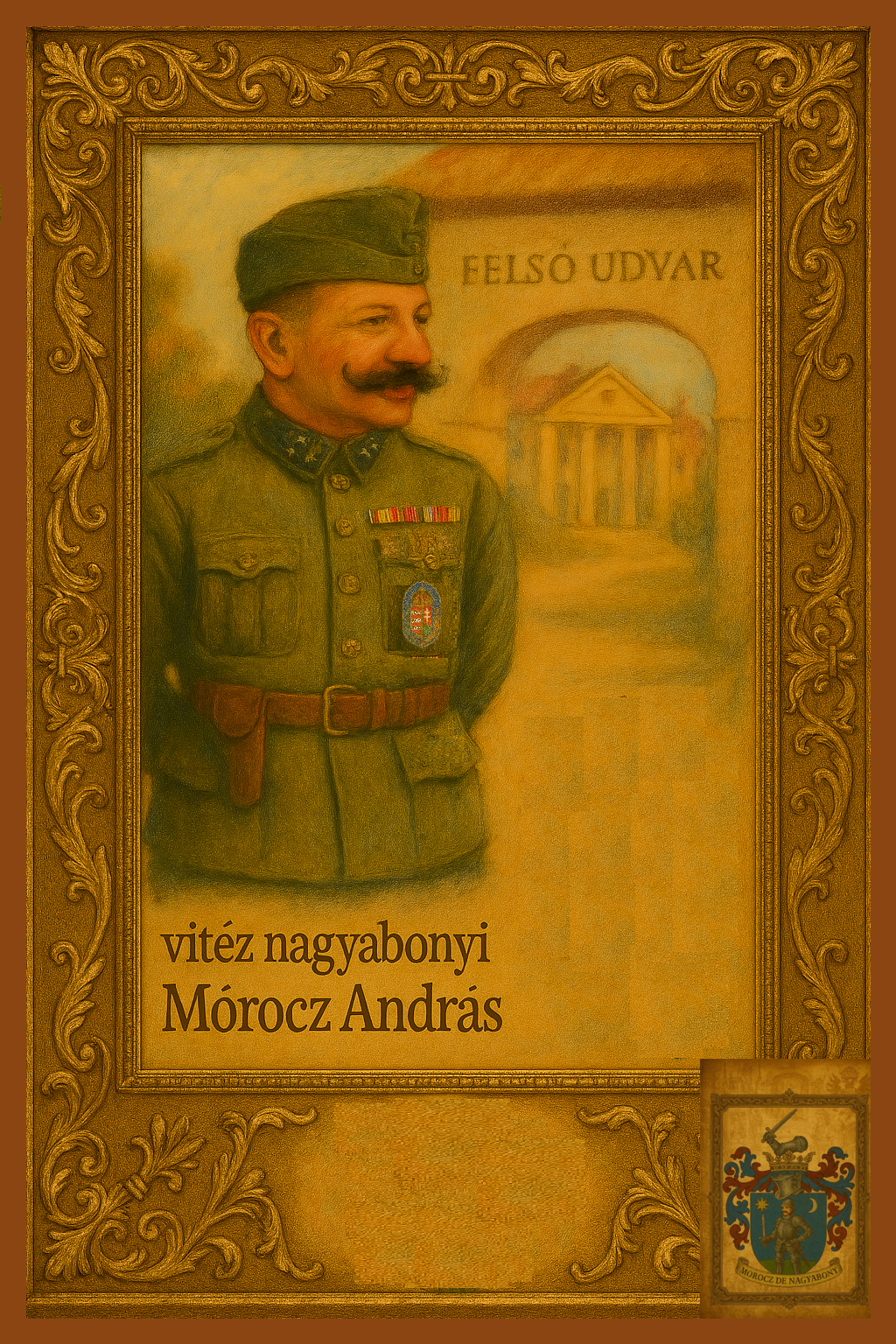 vitéz András Mórocz de Nagyabony
The record (proposal no. 90722) and the subsequent conferral of the Silver Medal for Bravery, 1st Class, were essential prerequisites for his later induction into the Order. For enlisted men and non-commissioned officers, this medal was the true gateway to the title of "vitéz".
In recognition of his distinguished service, he was inducted into the elite Order of vitéz in 1938. Although a member of the landed gentry and a bearer of the title vitéz, he participated in the occupation of Transylvania in 1940 with the non-commissioned rank of Hussar Sergeant. This was due to the fact that in the Hungarian army, the rank held during the Great War did not automatically change upon being knighted as a vitéz; as a vitéz from the enlisted ranks, he maintained his NCO line. Nonetheless, the position of a Sergeant in the Hussars represented the absolute social and military elite, reserved for the finest riders and most seasoned warriors, thereby confirming his status as a veteran front-line hero who earned respect not through rank, but through personal sacrifice and gallantry.
Ján Róbert Mária Mórocz (born 1985 in Bratislava) is a direct descendant of the historic noble family Mórocz de Nagyabony. He hails from the prominent donation line of Ambróz (the Jahodná/Eperjes branch), whose joint lordship over Nagyabony was confirmed by King Ferdinand III. A key milestone was the year 1718, when King Charles III issued the Salva Guardia (protection letter) recorded in the Libri Regii, confirming the family's property and legal continuity.
On May 24, 1823, the noble status and the title "de Nagyabony" were officially confirmed for the Jahodná (Eperjes) line. Róbert is the great-great-great-grandson of Antal Mórocz, who was recorded in the deeds as a verified direct descendant of the Mórocz de Nagyabony lineage. A notable ancestor was his great-grandfather Vitéz Andreas Mórocz de Nagyabony, a hero of the First World War and a member of the prestigious Order of Vitéz.
The blood of ancient noble houses such as Görföl de Nagyjóka, Ollé de Ollé-Tejedi, Farkas de Nagyjóka, and Tajnay de Tajna flows through this lineage. In 2022, in Máriapócs, Róbert was knighted as a hereditary knight by Archduke Joseph Karl von Habsburg-Lothringen, continuing the family tradition within the order, which brings together European dynasties and magnate families such as Batthyány, Széchenyi, Pallavicini, Festetics, and others.
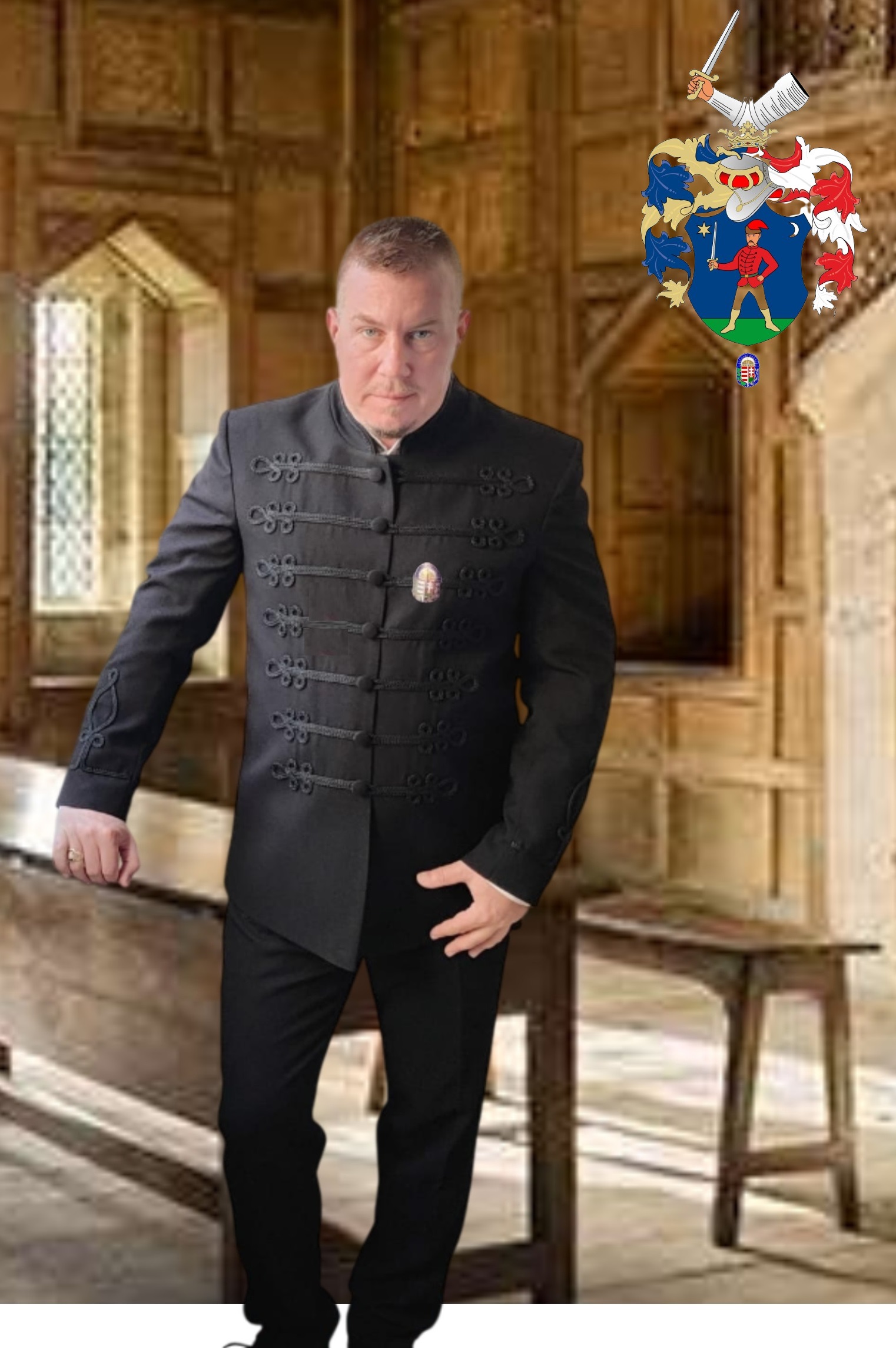 vitéz Róbert Mórocz of the House de Nagyabony
Róbert’s profound personal mission is to preserve his family name and historical honor for future generations. Through his active engagement, he purposefully strives to ensure that the name Mórocz de Nagyabony is never forgotten and firmly maintains its place within the consciousness of today’s modern European aristocracy.
Róbert seeks to preserve the legacy of his ancestors in his daily life together with his wife. Lady Andrea Reseková (Mórocz Reseková by marriage) comes from a prominent family of magistrates. Her great-great-grandfather Carolus (Károly) Reszek served as the long-standing Mayor (Bíró) of Malacky from 1856 to 1867, integrating the tradition of public service and regional authority into the family line.
Róbert holds a diploma confirming his noble descent, and his family coat of arms, augmented with the insignia of the order, has been officially recognized and digitized by the heraldic commission.
Inquire / Share
Would you care to share your knowledge regarding the House of Mórocz de Nagyabony, or do you have inquiries concerning this lineage? Pray, send us a message.