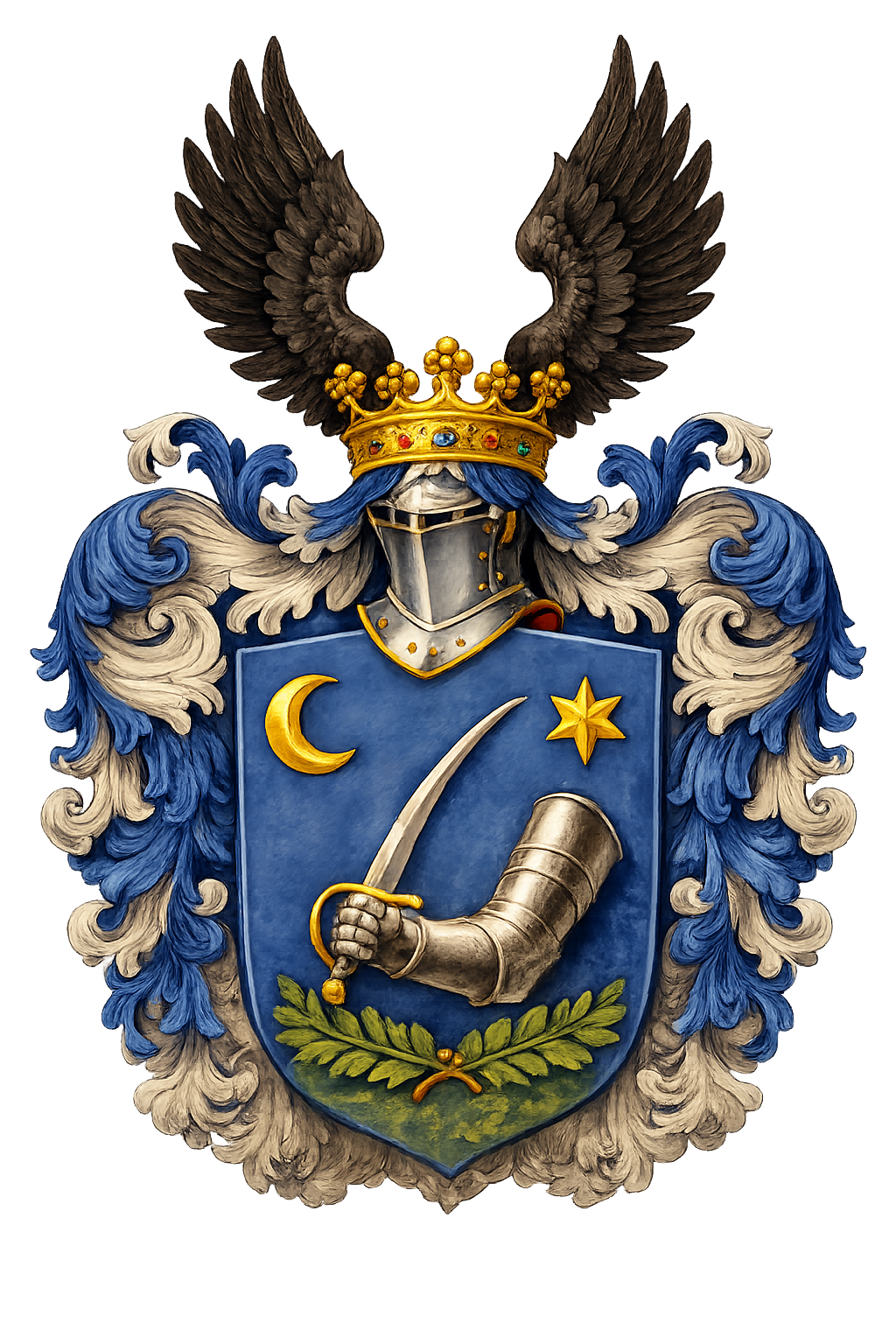
The Strategic Ascent of the "Ancient Fir"
The history of this house, graced by the motto "Abies altior Antiquitatis MOROCZ" (The Higher Fir of the Ancient Mórocz), is not a tale of accidental elevation, but a testament to the purposeful territorial expansion of ancient noble blood from the Žitný ostrov (Schütt Island).
Origins and First Footsteps in Beketfalva (1549)
The lineage finds its roots in the ancient noble clan Mórocz de Nagyabony, specifically with Benedict Mórocz. His presumed grandson, Georgius (George) Mórocz, is recorded in Beketfalva in 1549 as a "subject of his Royal Majesty" (colonus regiae maiestatis). This record reflects the fact that the family resided in the settlement at that time, though they did not yet possess the local lands as a manorial estate.
Peter "Aquisitor" and the Manorial Shift (1560 – 1572)
The pivotal figure in the family's rise was George's son, Petrus (Peter) Mórocz, rightfully designated in charters as "Aquisitor" (the Acquirer) of Beketfalva. Analysis of the records reveals that Peter secured this property through a strategic transaction from the high-born Potentiana Dersffy de Szerdahely. The fact that Peter acted as an equal partner in property dealings with such prominent magnates as the Dersffy family confirms his own noble standing and considerable financial power. Peter further consolidated his position through marriage to Catherine Dani, a daughter of the local gentry.
 1572 - Coat of Arms of the Mórocz de Beketfalva lineage („Source: Wikimedia Commons“)
The crane holds a stone in its raised claw. According to heraldic legend, should the crane fall asleep, the stone would drop onto its other foot and awaken it – in heraldry, this symbolizes perpetual vigilance in the service of the Sovereign.
Official Separation of the Branch and County Career (1572 – 1579)
In 1572, Peter achieved a significant legal milestone. Along with his son Antonius (Anton), he received Letters Patent (armales) from Emperor Maximilian II. This was not a nobilitation of commoners, but a grant of a distinct coat of arms and the noble predicate "de Beketfalva". By this act, the family was officially separated from their kinsmen in Nagyabony. Anton confirmed this status in 1579, while serving as a Noble Magistrate (Iudlium) of Pozsony County under the leadership of Vice-Isphan (Vice-comes) Francis Eszterházy.
The Mórocz de Beketfalva family successfully transformed their ancient lineage into modern influence. The key to their success was Peter Aquisitor, who in the mid-16th century leveraged his standing and wealth to acquire Beketfalva from the House of Dersffy, thus laying the foundations for one of the most prominent administrative dynasties of Pozsony County.
Peak in State Administration and Aristocratic Alliances (Wolfgang and Stephen)
Succeeding generations transformed local influence into national authority:
Wolfgang (Volfgangum) Mórocz: Son of Anton, who in 1632 became the Vice-Isphan of Pozsony County and later served as a Royal Assessor of the Royal Court of Justice, a Royal Counselor, and the Vice-Palatine of the Kingdom of Hungary.
 Wolfgang Mórocz de Beketfalva („Source: Wikimedia Commons“)
In 1646, Wolfgang Mórocz was appointed Vice-Palatine by the new Palatine, Count John Draškovič, who found in him a key collaborator for the administration of the realm due to his extensive experience and influential connections in Pozsony (Pressburg). He held this eminent position at the height of his power until 1648, when he retired due to advanced age, passing away shortly after drafting his last will and testament.
Stephen (Stephanus) Mórocz: Wolfgang's son, who also served as Vice-Isphan in 1655. He finalized the family's social ascent through his marriage to Susanna Amadé (Susana Amadea), by which the lineage definitively merged with the ancient Hungarian aristocracy. After her passing, his subsequent spouse was Anna Kerekes de Szentgyörgy.
Furthermore, Wolfgang’s granddaughters entered into marriages with the illustrious Eszterházy and Széchényi families.
 Armorial seal of Wolfgang Mórocz de Beketfalva („Source: Wikimedia Commons“)
Wolfgang Mórocz established a vast estate in the Žitný ostrov (Schütt Island) region, beginning with a modest inheritance in Beketfalva and expanding through the acquisition and mortgage-holding of manors such as Vojka, Blatná na Ostrove, and Malá Lúč. Thanks to his distinguished career and the acquisition of properties from the Pálffy family (Igram, Svätý Jur), the lineage was ranked among the wealthiest Hungarian nobility by the mid-17th century.
Baron Emericus Mórocz de Beketfalva
Baron Emericus (Imrich) Mórocz de Beketfalva (1697 – 1758) was a prominent Hungarian nobleman and one of the most distinguished generals of the Maria Theresa era. Although he began his career in more modest circumstances as an official under Palatine Pálffy, his courage and military talent led him to the rank of Imperial Lieutenant Field Marshal, commanding his own hussar regiment.
 Baptismal record from 1697 („Source: Wikimedia Commons“)
The parish register entry confirms the baptism of Emericus Leopoldus, born into an influential noble environment. His father was Franciscus Mórocz de Beketfalva and his mother was Eva Theresa Jakusith (Jakusics), daughter of Baron Emericus Jakusith, after whom he was likely named. His godparents were eminent figures of the time, including the General War Commissioner Johann Jakob Löwenburg and his wife, foreshadowing Emericus's later illustrious military career.
He gained fame primarily in the campaigns against the Prussians, most notably at the pivotal Battle of Kolín, where his cavalry played a decisive role in the victory of the Austrian forces. For his military merits, he was elevated to the rank of Baron and is still regarded today as a symbol of the rise of the educated military strategist of the 18th century.
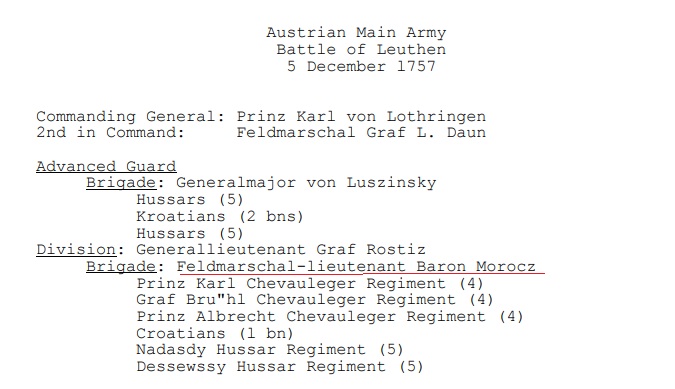 Deployment record of Emericus at the Battle of Leuthen 1757
In December 1757, during the Battle of Leuthen—one of the largest engagements of the Seven Years' War—Baron Emericus Mórocz held a key command position. Serving with the rank of Lieutenant Field Marshal (Feldmarschall-Lieutenant), he commanded a cavalry brigade within the division of Lieutenant General Count Rostiz. His direct command included an elite formation of light cavalry and infantry as part of the Advanced Guard. Mórocz's brigade comprised three regiments of chevau-légers (light horse), a battalion of Croats, and two hussar regiments, including the famous Nádasdy Hussars, confirming his reputation as a specialist in maneuver warfare and the command of mobile units.
The Ancestral Seat in Beketfalva: Representation and Defense
In the first half of the 17th century, Wolfgang Mórocz initiated the construction of a new ancestral residence in Beketfalva, intended to reflect the family's burgeoning influence. The project, completed by his descendants, was a grand seat featuring a four-wing layout and three inner courtyards. On 18th-century maps, the structure is designated as a Castellum, signifying its importance was comparable to the estates of the highest Hungarian nobility.
 Sketch of the Manor House in Beketfalva („Source: Wikimedia Commons“)
A historical sketch from Adam Hankóczy's map provides a unique visual record of the now-vanished Mórocz residence in Beketfalva. The depiction is dominated by the monumental four-wing floor plan of the main palace, enclosing the inner courtyards, and clearly showing three massive corner bastions designed for defense against the Ottoman threat.
Given the prevailing Ottoman danger of the era, the manor house was also designed as a fortress. It was protected by three large bastions at the corners and likely an earthen rampart or a water moat. Although Beketfalva was but a small settlement, this residence transformed it into a significant regional landmark, as evidenced by its inclusion on Vischer’s prominent 1685 map of Hungary alongside imperial fortresses. Today, this illustrious era is remembered only by Mórocz Street and fragments of a historical outbuilding.
Confirmation of Nobility and Grant of Arms to the Mórocz de Martos Lineage in 1601
In 1601, King Rudolph II confirmed the ancient noble privileges and granted a new coat of arms to a collective kin group, in which the brothers Gregorius (Gregory) and Blasius (Blaise) Mórocz de Martos played a pivotal role. The charter explicitly mentions Blaise’s sister Elizabeth and his daughter Anne, thereby formally encompassing this entire branch of the family.
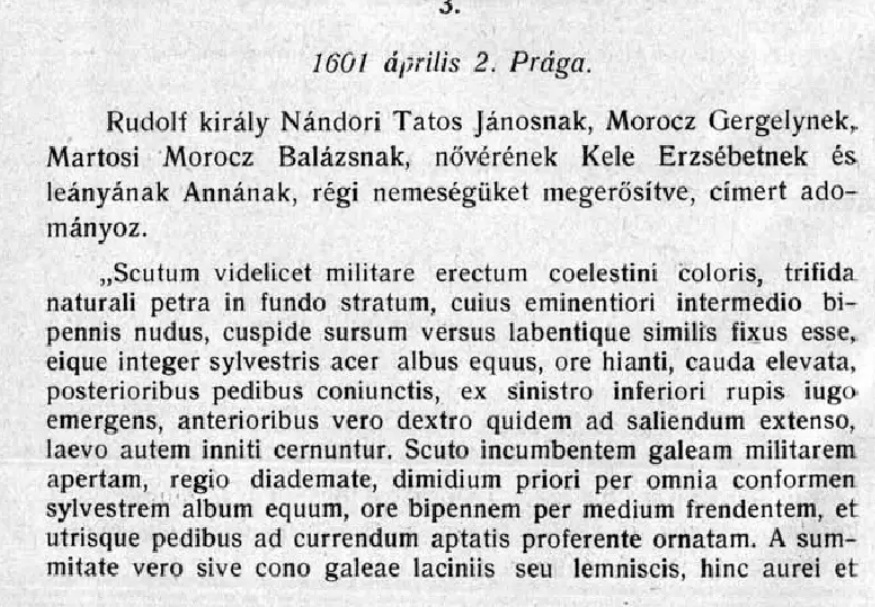 Record of the 1601 Confirmation of Nobility and Grant of Arms
April 2, 1601, Prague. King Rudolph grants a coat of arms to John Tatos de Nándor, Gregory Mórocz, Blaise Mórocz de Martos, his sister Elizabeth Kele, and his daughter Anne, while confirming their ancient noble standing.
Crucial to the historical continuity of the house is their direct lineage: both brothers were the sons of Paulus (Paul) Mórocz de Beketfalva, who was the son of Petrus (Peter) Mórocz de Beketfalva. By this royal act, the Sovereign not only recognized the merits of the living members but formally linked the Martos line with their direct ancestors from the ancestral seat of Beketfalva, definitively sealing the family's prestigious standing within the Hungarian hierarchy.
Inquire / Share
Would you care to share your knowledge regarding the House of Mórocz de Nagyabony, or do you have inquiries concerning this lineage? Pray, send us a message.