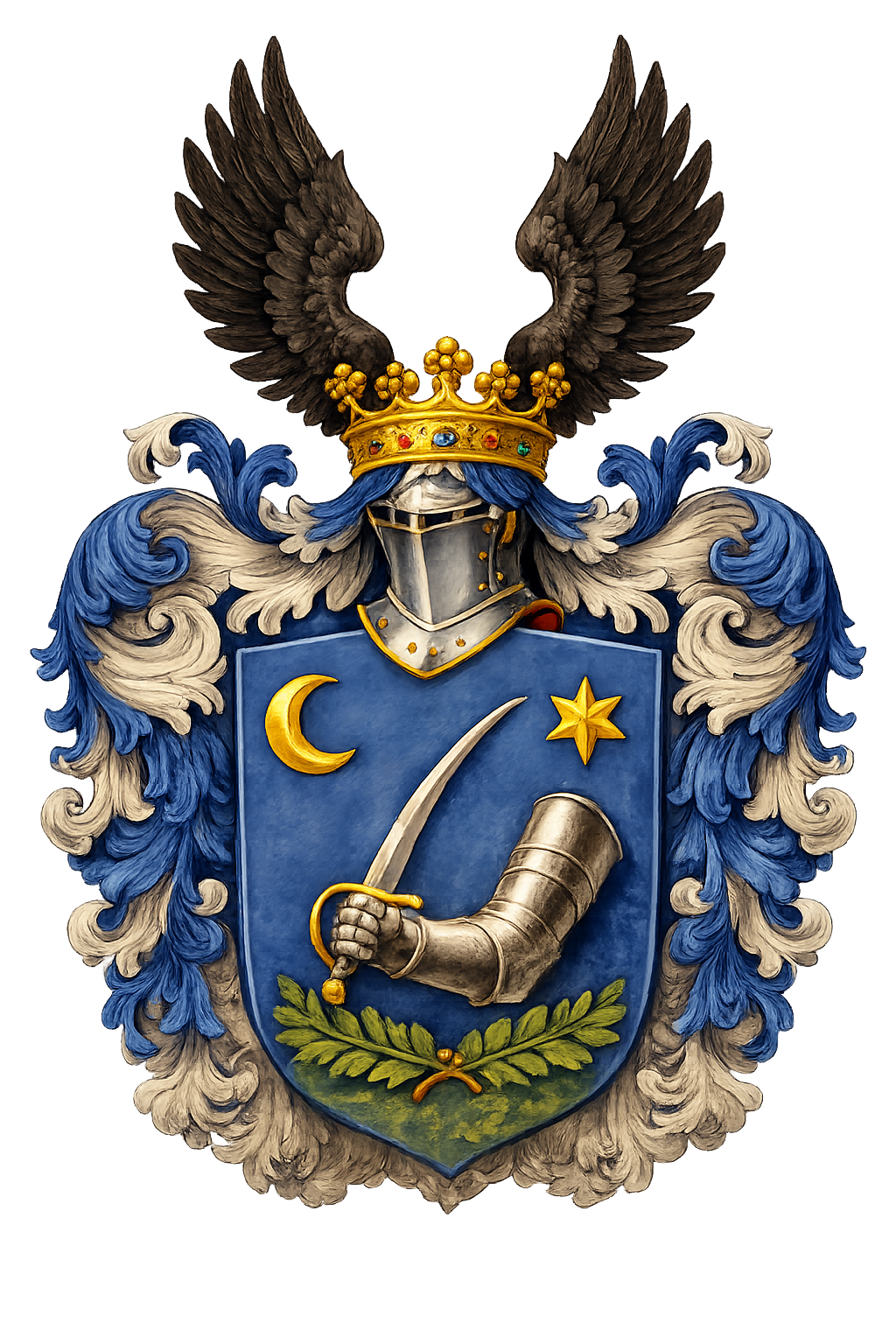
Antiquity as a Dynastic Certificate
The history of the Hungarian nobility is often viewed through the prism of powerful baronial houses. However, the true genetic and legal continuity of old Hungary is hidden in the charters found in the archives of the Rye Island (Csallóköz). The story of the clans from Veľké Blahovo (Nagyabony), documented by the charters of Kings Béla IV and Andrew III, represents one of the oldest and best-documented examples of the formation of the noble estate in Central Europe.
 King Stephen III („Source: Wikimedia Commons“)
King Stephen III granted them land under the name Oboni (Abony), laying the foundation for one of the longest continuous land tenures in European history. This act was not merely a gesture of royal favor, but a strategic decision to bolster the country's defense with free warriors who later formed the core of the local nobility. Without this initial 12th-century impulse, the later legal continuity documented by Béla IV and Andrew III would not have been possible.
In the history of European nobility, there are very few examples of families that managed to survive the turbulence of centuries on the same piece of land. While the European aristocracy is often defined by migration, the purchase of estates, and political downfalls, the clans of Veľké Blahovo (Abony) represent a global rarity. Their story is not just a Slovak or Hungarian curiosity, but a European unique in terms of land tenure continuity.
To speak of them is to speak of one of the oldest and most stable layers of nobility on the continent, with roots reaching back a millennium. The history of medieval Europe is a history of movement and transformation. The story of the Veľké Blahovo clans (Nagyabony), captured in royal charters from the 13th century, is a fascinating study of how a group of military specialists managed to transform within three generations from "guests" (hospites) into full-fledged Hungarian nobility. This process was not only a legal act but also a deep cultural and ethnic assimilation that created the unique phenomenon of the Rye Island gentry.
Charter of King Béla IV from 1236
Béla, Dei Gratia, Rex Hungariae, universisi praesentem paginam inspecturis, salutem in vero salutari. Quia labilis est hominum memoria, et rerum turbae non sufficit; idcirco solerti ingenio est expertum, ut ea, quae hic longa post tempora noscuntur recordanda, fideli memoriae litterarum commendentur. Universitati igitur vcstrae praesentium tenore cupimus fieri manifest, quod Chyba, lbur, Heym, Sid, Pocus, Karachun, Illerus, Sath, Hugel, Nolch, Ioanus, Clemen, Stegun et Omodias, ad nostram accedentes praesentislichani regentis, fenomen de l'Registration quondam Praedecessoris nostri, filii secundi Geyche, in quibus habebatur, quod proauis ipsorum de Bohemia venientibus in Ungariam, terram, in qua fuerant hospitati, dictus. remanere; oblatores igitur dictarum litterarum a nobis petierunt obnixe:quod ipsos libertate Iobbagionum Udvarnicorum nostrorum donaremus. nostrorum donaremus. Nos igitur petiteem ipsorumfectu condigno frekventantes, in hac parte, maxime propter hoc, quod sicut fideli nostro Dionysio Palatino, et Comite Bihoriensi, aliisque quibusdam regni nostri Baronibus referentibus percepimus, per vererabilem Dominantou Partem, ungariaad, libertate fuerant decorati; ipsos ct haeredes ipsorum haeredumque followores, in terra, nomine Oboni, quam per dictum Stephanum Regem eis collatam fuisse dicimus, libertate praedictorum Iobbagionum Udvarnicorum, secundum projectem ipsorum, duximus vestiendos; ita quod nullus nostrorum successorum ipsos in aliquo, praeter libertatem ultra susceptam valeat aggrauare. Ut igitur hoc ratum et-firmum habeatur, praesentem paginam dupplicis sigilli nostri munimine fecemus perpetuo roborari. Dátum anno Domini Millesimo, ducentesimo trigesimo sexto. Septima idus Novembris, regni autem nostri anno secundo.
"Béla, by the Grace of God, King of Hungary, to all who shall read this page, greetings in the true Savior. Since the memory of men is fleeting and sufficeth not for the multitude of events, it hath been found by skillful wit that those things which are to be remembered after a long time should be entrusted to the faithful memory of charters. We desire it to be known to your community through the tenor of these presents that Chyba, Ibur, Heym, Sid, Pocus, Karachun, Illerus, Sath, Hugel, Nolch, Ioanus, Clemen, Stegun, and Omodias, appearing before our presence, presented a charter of our predecessor King Stephen (III), son of Géza II, wherein it was stated that to their ancestors, coming from Bohemia to Hungary, the land upon which they had been settled should remain. The presenters of the said charter did therefore earnestly beseech us that we should grant them the liberty of our Royal Servants (Iobbagiones Udvarnicorum). We have thus heard their petition with due favor, especially since, as we have learned from our faithful Palatine Dionysius, Count of Bihar, and certain other Barons of our realm, they had already been adorned with this liberty in the time of our predecessor. Themselves, their heirs, and the followers of their heirs on the land named Oboni (Abony/Veľké Blahovo), which we say was granted to them by the aforementioned King Stephen, we have decided to invest with the liberty of the said Royal Servants according to their request; so that none of our successors may burden them in any way beyond the liberty they have received. That this may be held valid and firm, we have caused this page to be forever strengthened by the protection of our double seal. Given in the year of our Lord one thousand two hundred and thirty-six. On the seventh day before the Ides of November (November 7th), in the second year of our reign."
The Formation of a "Nobility-in-Waiting"
The noble families of Veľké Blahovo (Abony) belong to the oldest continuously documented indigenous nobility in the entire Kingdom of Hungary. Their story does not begin with an ennoblement for services rendered, but dates back to an original royal donation in the 12th century.
According to King Béla IV's charter of 1236, the ancestors of these families arrived in Hungary during the reign of Stephen III (1162–1172) as so-called "Bohemian guests" (Hospites Bohemi). These were not ordinary settlers, but an elite group of freemen—presumably exiled Bohemian nobles or knights—to whom the King granted the land of Abony and allowed them to retain their original liberties and rights.
The key moment in their history is the confirmation of their status as "royal court servants" (Iobbagiones Vduarnicorum). This meant that the entire community of Abony enjoyed collective noble liberty—they were not subjects of any landlord, but were answerable directly and exclusively to the King. Their sole obligation was military service under the royal banner.
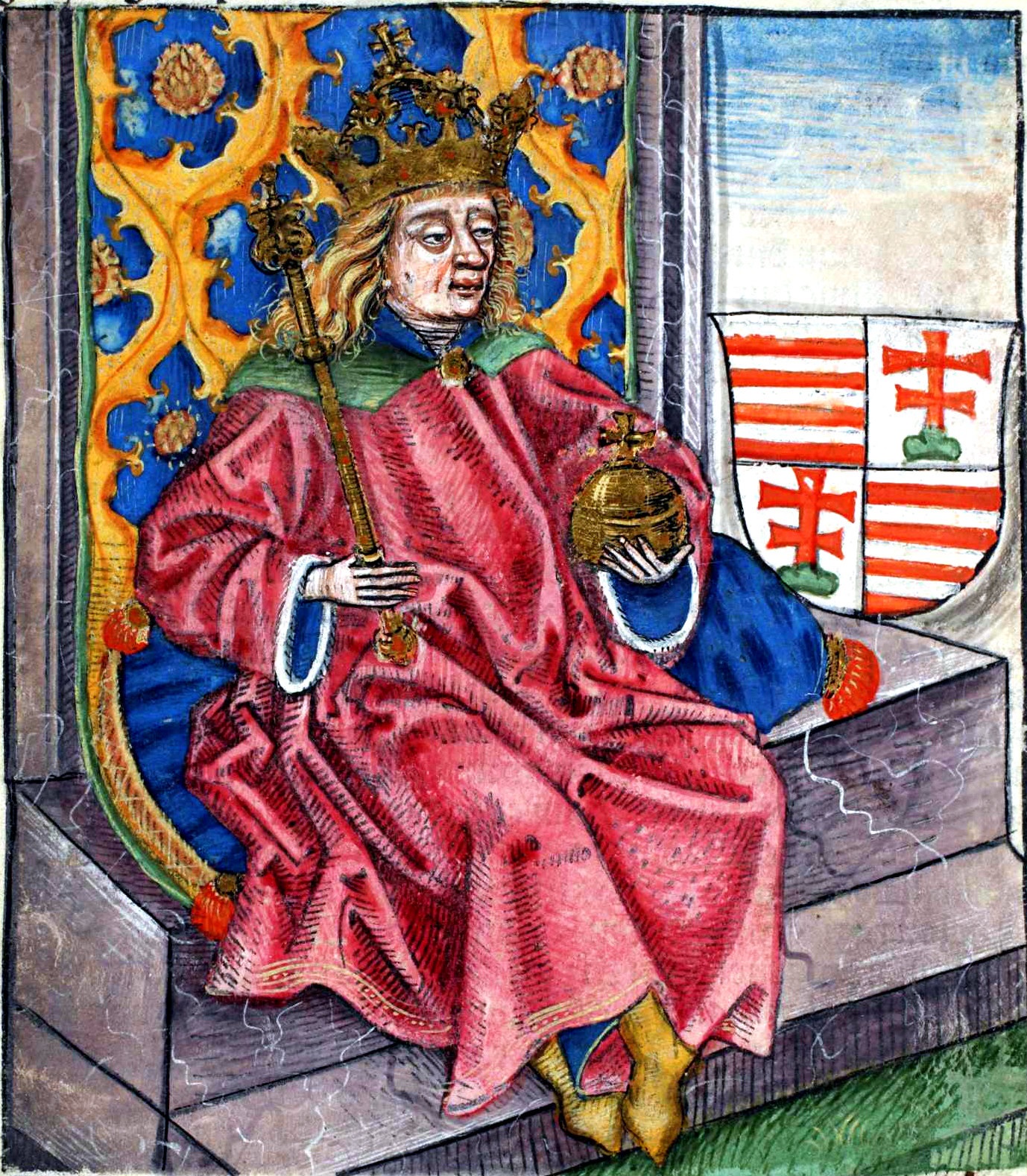 King Béla IV („Source: Wikimedia Commons“)
Béla IV played a key role in the story of the Abony clans as the monarch who legally stabilized their position in 1236. His charter names individual members of the community for the first time, transforming an anonymous group of settlers into specific historical actors.
By the time the first charter was issued, they were already an assimilated "mix" – the descendants of the original settlers had formed into an ethnically diverse but socially unified group. Their identity was no longer Bohemian, but based on their social estate. They appeared before the monarch as confident "Royal Servants" (Iobbagiones Udvarnicorum), fully aware of their value to the Crown.
The 1236 charter is crucial because it fixes their status as free men subject directly to the King. Although the formal title "Nobilis" is still absent from the text, their standing was already noble in practice. They were a "nobility-in-waiting", biding their time for the right historical moment to convert their factual power into a hereditary legal title.
John of Abony: Through Valor to the Title
This defining moment arrived in 1299, when King Andrew III definitively elevated the Blahovo clans to the ranks of the full-fledged Hungarian nobility. While the 1236 charter addressed the group as an anonymous collective, in 1298 a specific figure emerged – John of Abony (Iohannes), son of Nicholas.
 Andrew III („Source: Wikimedia Commons“)
King Andrew III was the monarch who, in 1299, concluded the nearly 150-year process of forming the Blahovo nobility. It was he who exchanged their previous status of royal servants for the full title of Nobilis (Nobleman).
It was John's personal heroism in the battles against Duke Albert of Austria, where he exposed himself to grave dangers and shed his own blood, that became the final argument for royal grace. This individual act of bravery served as the key to the elevation of his entire group of kinsmen and fellow warriors: Iaka, Marczel, Matthe, Csyba, Bug, Andreas, and Musgun.
Hereditary Land and Eternal Glory
The final act of this saga was the granting of the land Fel-Abony (Upper Blahovo) into hereditary possession. With this legal act, the circle was closed: from guests, they became masters of the house, owning the land "for all eternity."
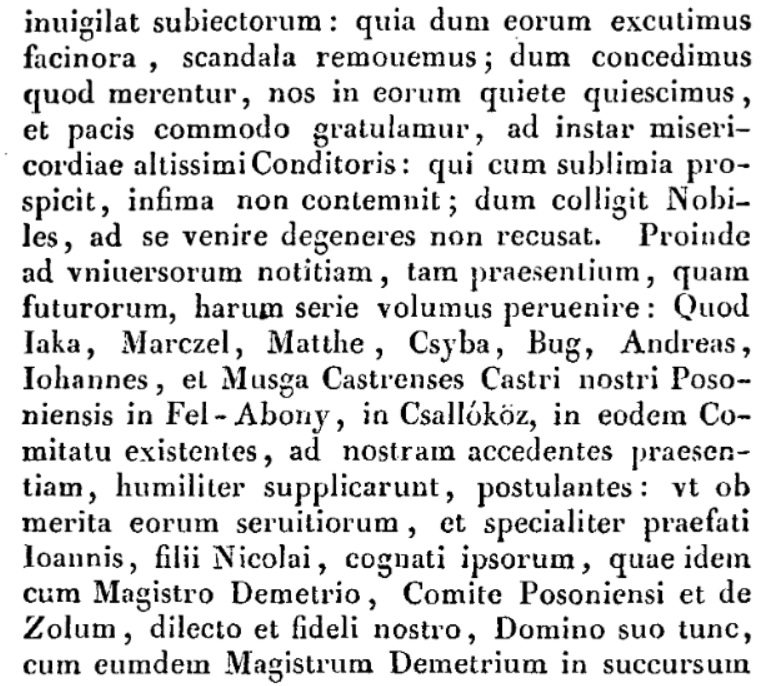 1299 Nobilitation of the Abony Clan
This excerpt from King Andrew III's charter (1299) confirms the ennoblement of the clans from the locality of Fel-Abony (Upper Blahovo), who until then were under the jurisdiction of Bratislava Castle. The document mentions specific representatives such as Iaka, Marczel, Csyba, or Bug and explicitly states their seat in Fel-Abony within the Rye Island (Csallóköz). In the text, the King highlights the heroic deeds of John, son of Nicholas, performed under the command of the Count of Bratislava, Demeter.
For the merits of John, son of Nicholas, the King performed two crucial legal acts:
Ennoblement: He removed them from their original status of servants and included them in the "community of the nobles of the realm" (in numerum et coetum Nobilium Regni).
Hereditary Tenure: The King granted them the land of Fel-Abony (Upper Blahovo) in hereditary ownership. Thus, their holding became a noble manor, and they became full-fledged landed gentry who owned the property forever.
The Uniqueness of the Blahovo Origin
In the context of European genealogy, this case is extraordinary. The origin of the Blahovo clans does not rely on legends, but on deeds backed by blood of specific men. John of Abony and his kin are living proof of this history – their names and status have endured in the region for more than 850 years.
Veľké Blahovo stands in history as a monument to one of the oldest documented noble lineages. The charters of 1236 and 1299 prove that the path to nobility led through loyalty to the monarch and courage on the battlefield, with figures like John, son of Nicholas, remaining forever inscribed as the architects of the glory of future Blahovo families.
The Power of Customary Law and Silent Nobility
In the 17th century, when Habsburg absolutism demanded written proof of origin, the clans of Blahovo presented not only ancient parchments but their own indispensability. As part of the Végvár (Border Fortress) defense system, they formed a military elite defending Christian Europe against Ottoman expansion. The charter of Ferdinand III from 1641 is an expression of the monarch's deep respect for their standing.
The address "Egregius et Nobilis" (Illustrious and Noble) was not intended for ordinary petty gentry. It belonged to the middle nobility (landed gentry) who formed the political and military core of the Bratislava County. These ten clans – Csiba, Szelle, Morocz, Csomor, Kázmér, Gyárfás, Brissel, Dobos, Posa, and Böke – were not subjects of any castle. They were "Domini Terrestres" (Lords of the Soil), ruling over the entire district of Veľké Blahovo and Nádvar as a sovereign collective.
What makes these clans exceptional is their ability to survive without the ostentation of high titles. While counts and barons often acquired their titles through diplomacy or wealth, the Blahovo nobility "wrote their freedom in blood" on the battlefield and defended it with labor in the fields. Their "registry" was the land itself. The strength of the Blahovo compossessorate (co-ownership) was so great that their manorial rights had to be confirmed by monarchs such as Charles VI in 1718.
 King Charles VI („Source: Wikimedia Commons“)
In 1718, Charles VI confirmed the ancient manorial rights of the Veľké Blahovo clans, definitively recognizing their exceptional status in the era of emerging modern bureaucracy. His charter was crucial because, at a time when many old houses were losing their privileges, it confirmed the sovereignty of the Blahovo compossessorate over their territory.
These families were not just inhabitants of the village; they were its legislators, judges, and protectors. Their status as landed gentry allowed them to influence the affairs of the entire county, while maintaining the authenticity of clans that never left their "cradle".
The clans of Veľké Blahovo are a living monument to European history. They are proof that true aristocracy is defined not only by heraldry, but above all by continuity and loyalty to one's own land. Their thousand-year presence on the same soil is a monument that surpasses castles and palaces. They are the silent giants of the Rye Island, whose names are inscribed not only in archival codices but in the very genetic code of our country.
The charters of 1641 and 1718 are essentially a capitulation of monarchical bureaucracy to ancestral tradition. Kings had to recognize that the pride and antiquity of these clans were stronger than any new law. By confirming their estates, the monarchs indirectly admitted: "You belong to the oldest elite, and we respect your thousand-year tenure because you are unsurpassed in this region."
The Nobility of the Blahovo Clans
The nobility of the clans from Veľké Blahovo was not merely a formal title granted by a royal chancery, but a natural consequence of their thousand-year roots in the soil. While many aristocratic families acquired their prestige through political maneuvering or strategic marriages, the Blahovo nobility preserved what is most precious in genealogy – absolute stability and continuity.
Within the Rye Island region, they enjoyed natural respect as the "old lords," whose rights were derived not from the will of barons, but from direct service to the King and their own land. Their nobility (Generositas) bore the essence of sovereignty and inner freedom; they were not subjects bound by duties to other masters, but proud sovereign co-owners of the entire district.
In the region, their name was a guarantee of antiquity that survived medieval wars, Ottoman threats, and social upheavals, maintaining the silent nobility of clans that know their own worth without the need for ostentatious gestures.
At a time when the map of Europe was still being redrawn, the Blahovo clans already had their freedom sealed with royal wax. This eight-hundred-year-old rarity reminds us that although kingdoms turn to dust, honor and ancestral continuity are stronger than time itself. Blahovo is not just a point on the map of Hungary; it is a monument to European antiquity.
Inquire / Share
Would you care to share your knowledge regarding the House of Mórocz de Nagyabony, or do you have inquiries concerning this lineage? Pray, send us a message.