Nádvár and Nagyabony: A Fortress in the Shadow of the Ottoman Threat
During the turbulent 16th and 17th centuries, when the Kingdom of Hungary became a bloody buffer zone between the Habsburg Monarchy and the expanding Ottoman Empire, a crucial role was played not only by great royal fortresses but also by a dense network of smaller local strongholds. Among the most significant in the Rye Island region was Nagyabony, with its advanced fortification, Nádvár.
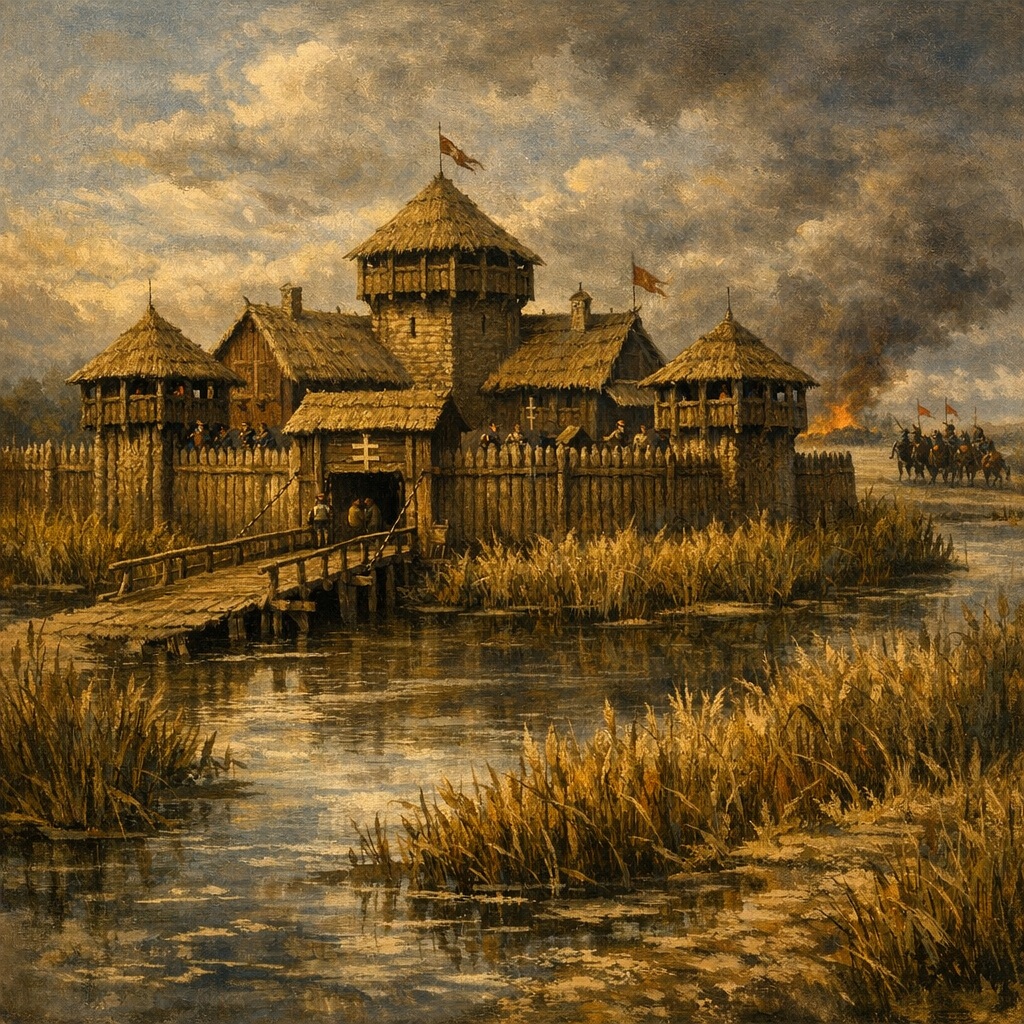 The Nádvár Fortress in the 17th Century
This visualization impressively captures the hypothetical appearance of the Nádvár fortress as a typical lowland fortification during the time of the Ottoman threat. The artistic depiction faithfully reflects the name "Reed Castle," placing the entire structure in a hostile marshy terrain with dense reeds that served as the first line of natural defense against enemy cavalry. The architecture of the fortress combines a central stone tower with wooden elements and outbuildings with thatched roofs, all protected by a massive wooden palisade and corner bastions. The overall dramatic atmosphere is completed by smoke rising from the horizon and the arrival of armed men at the drawbridge, underlining Nádvár's function as a strategic refuge for the local nobility and the surrounding population.
The name of the fortress, Nádvár, which literally translates to "The Reed Castle", precisely defined its military character. Unlike stone castles built on hills, Nádvár utilized the specific terrain of the Danubian Plain. It was located on the edge of the village territory, amidst an impenetrable labyrinth of the Danube's dead arms, marshes, and high reeds.
This location was a strategic masterpiece. For the Ottoman cavalry, these wetlands were a trap. Nádvár functioned as a refugium—a place of safety where the population took shelter during raids and where the defensive strength of the local nobility was concentrated.
Architecture of Contrasts: Fortified Manors and Mud Huts
To a person of that era, Nagyabony must have appeared as a fascinating cluster of security and poverty. The village did not consist of continuous streets, but rather a network of isolated fortified manors belonging to prominent families. Each such manor was a small fortress with a moat, an earthen rampart, and a palisade.
In sharp contrast to these noble residences stood the dwellings of the serfs. They were low, modest houses built from the cheapest materials the surrounding nature offered. The wattle and daub walls consisted of wickerwork coated with a thick layer of clay and chaff, which kept the heat in during winter and provided cooling in summer.
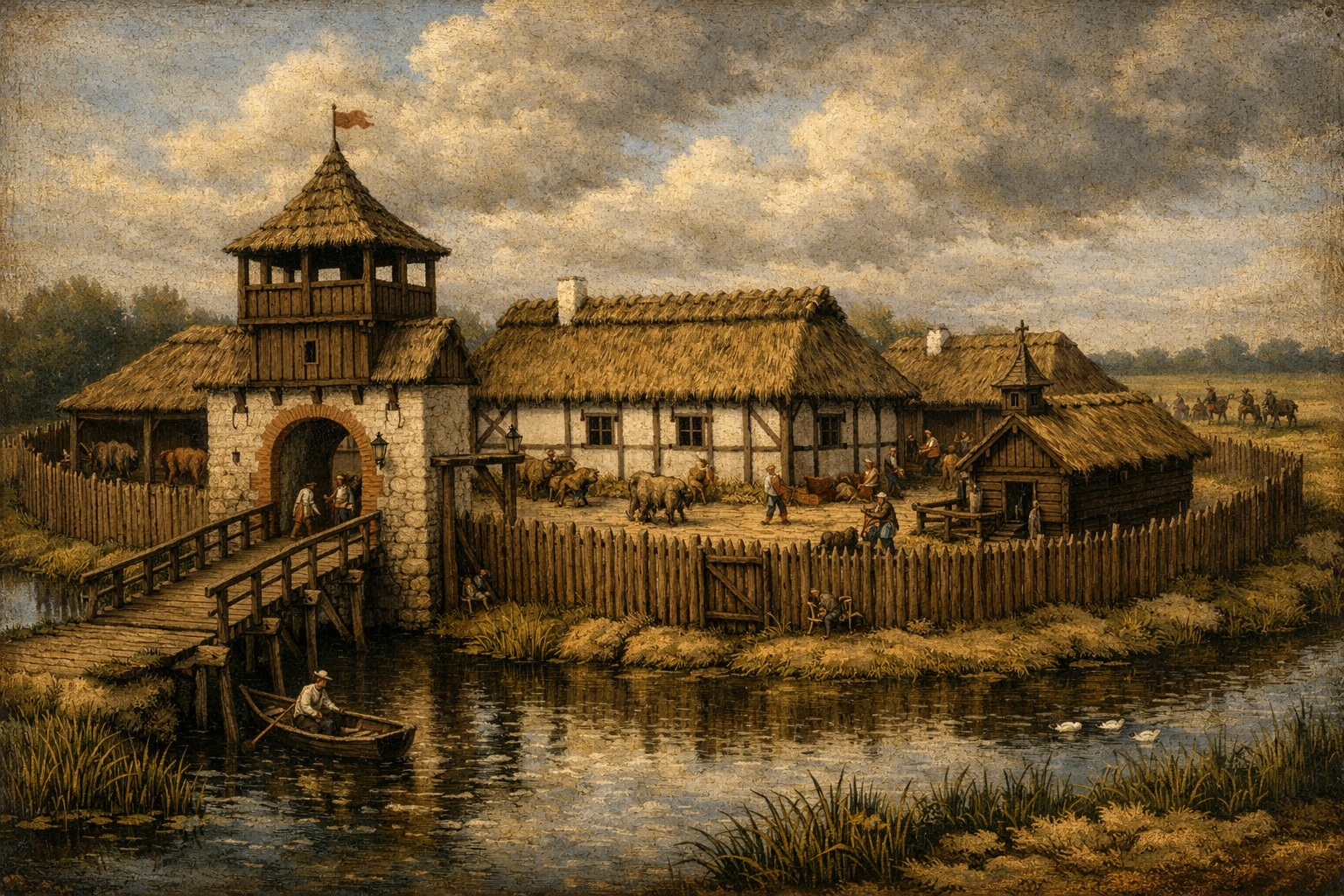 Noble manor in Nagyabony in the 17th century
This visualization represents a faithful likeness of a fortified noble manor, which in the 17th century combined the function of a family seat and economic hub with the necessity of constant defense. The dominant element is a masonry gate tower with a wooden superstructure, which, together with a massive palisade and a water moat, created a secure enclosed compound protecting both assets and inhabitants from minor raids. The architecture of the residential buildings, with their white walls and high reed-thatched roofs, reflects the period's aesthetics and the practical use of available materials from the Rye Island. The bustle in the courtyard, the presence of livestock, and a boat on the water in the foreground clearly illustrate that these manors were self-sufficient microworlds perfectly adapted to life in the wetlands of the Danubian Plain.
A characteristic feature was the high, steep reed roofs covered with a thick layer of reeds from the Rye Island. Although lightweight and waterproof, they presented a massive fire risk during Turkish attacks, where fire arrows were frequently employed.
“Egregii et Nobiles”: Defenders and Lords of the Territory
The defense of this territory did not rest upon the shoulders of a state army, but on the courage of local noble houses. Their extraordinary significance is evidenced by a charter from Emperor Charles VI, in which the monarch addresses the representatives of these families with the title “Egregii et Nobiles” (Illustrious and Noble).
According to confirmed donations, these families obtained "full and entire possession" over the entire territory of Nagyabony. Among these "Lords of Abony" who kept watch over Nádvár, the following are mentioned: Stephanus Brissel, Valentinus Szelle, Stephanus Csiba, Joannes Dobos, Ambrosius Morocz, Georgius Kázmér, Georgius Csomor, Petrus Pósa, Georgius Bőke, and Thomas Gyárfás.
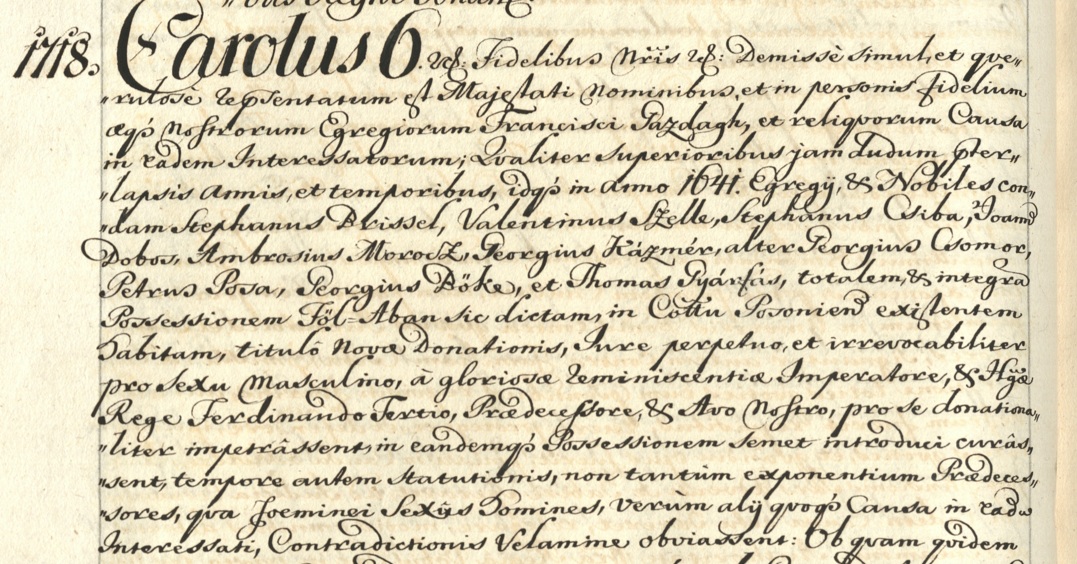 Charter from 1718 issued by King Charles VI
This historical document represents an excerpt from a Latin charter issued by Emperor Charles VI in 1718, as evidenced by the clearly legible name Carolus 6 and the date in the upper left corner. The charter is a key legal proof of the status and estates of the local nobility in Nagyabony, mentioned in the text under the historical name Föl-Aban within the Pressburg County. In the central part of the document, the honorary salutation Egregij & Nobiles stands out, followed by a detailed list of the names of defenders and landowners, where Ambrosius Morocz figures among the prominent figures. His name is clearly legible in the list, confirming that the Mórocz family was among the key holders of the watch over Nádvár and enjoyed full royal trust. The text further confirms the claim of the named individuals to full and entire possession of the estates, referring also to older legal acts from 1641, thereby definitively anchoring the social and property status of Ambrosius Morocz and his fellow combatants. Since the charter dates to 1718, it was created at a time when the Ottoman Empire had already been driven out of the territory of present-day Slovakia and Hungary (after the Battle of Vienna in 1683 and subsequent peace treaties). It was during this period that noble houses, such as the Mórocz family, had their ancient rights and estates, which they had owned and defended during the war times of the 17th century, officially confirmed by the monarch.
The Fall of Nádvár: The End of the Reed Shield
Although Nádvár resisted for a long time due to its inaccessible terrain, its fate was sealed in the second half of the 17th century. In 1663, after the fall of the strategic fortress of Érsekújvár (Nové Zámky), Ottoman forces and their Tatar allied detachments overran the entire Rye Island.
During this devastating offensive, Nádvár was eventually captured and completely destroyed. The Ottoman superior force, combined with the extensive devastation of the surroundings, resulted in the fortress being burned and razed to the ground. Unlike stone castles, the wood-and-clay nature of Nádvár meant its definitive end. The fortress was never rebuilt.
Legacy in Coat of Arms and Law
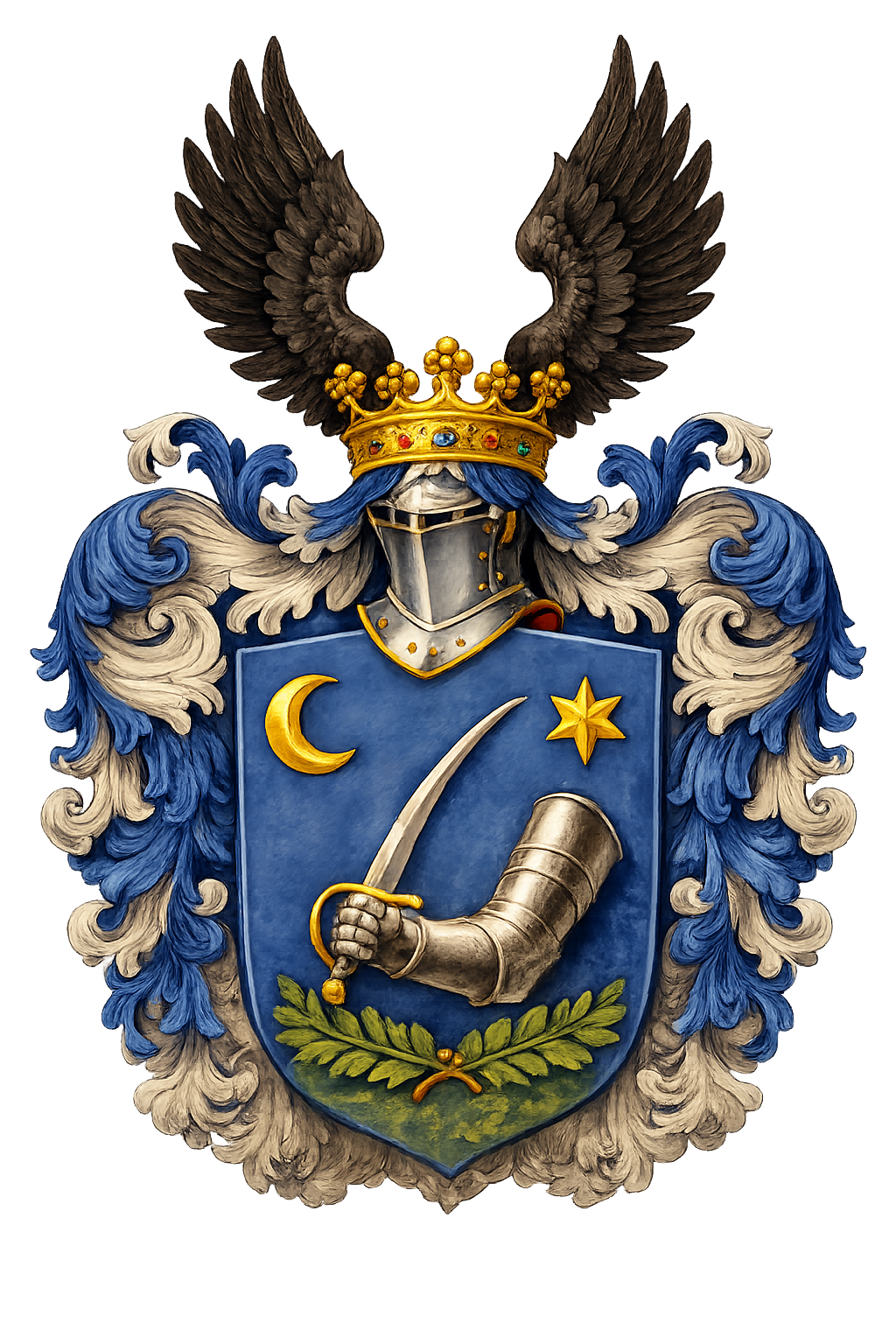
Even though the physical walls of Nádvár have vanished, the martial past remains inscribed in the village's heraldry. The armored hand with a sword in the coat of arms of Nagyabony serves as a permanent reminder of generations of landed gentry who had to defend their right to the land with weapons in hand.
The charter of Charles VI later confirmed that this right belongs to them „iure perpetuo et irrevocabiliter“ (perpetually and irrevocably) as a reward for their loyalty during times of greatest devastation. This legal act definitively closed the era of uncertainty and confirmed the status of lineages, such as that of Ambrosius Morocz, in the history of the Rye Island.
 Coat of arms of the village of Nagyabony (source: www.heraldry-wiki.com)
The coat of arms of Nagyabony is a striking heraldic symbol that refers directly to the martial past and noble origin of its inhabitants. In a Gules (red) shield dominates an Argent (silver) armored arm turned to the left, grasping an Or (gold) saber in its fist. This motif is typical of the family heraldry of the Hungarian nobility and symbolizes courage in defending the homeland and readiness to fight for one's rights. At the bottom of the shield, beneath the arm, are two crossed green laurel branches with tiny gold fruits, representing victory, honor, and the lasting glory of the local houses. The overall color combination of red, silver, and gold underscores the nobility and historical significance of the village as an important noble seat in the Rye Island region.
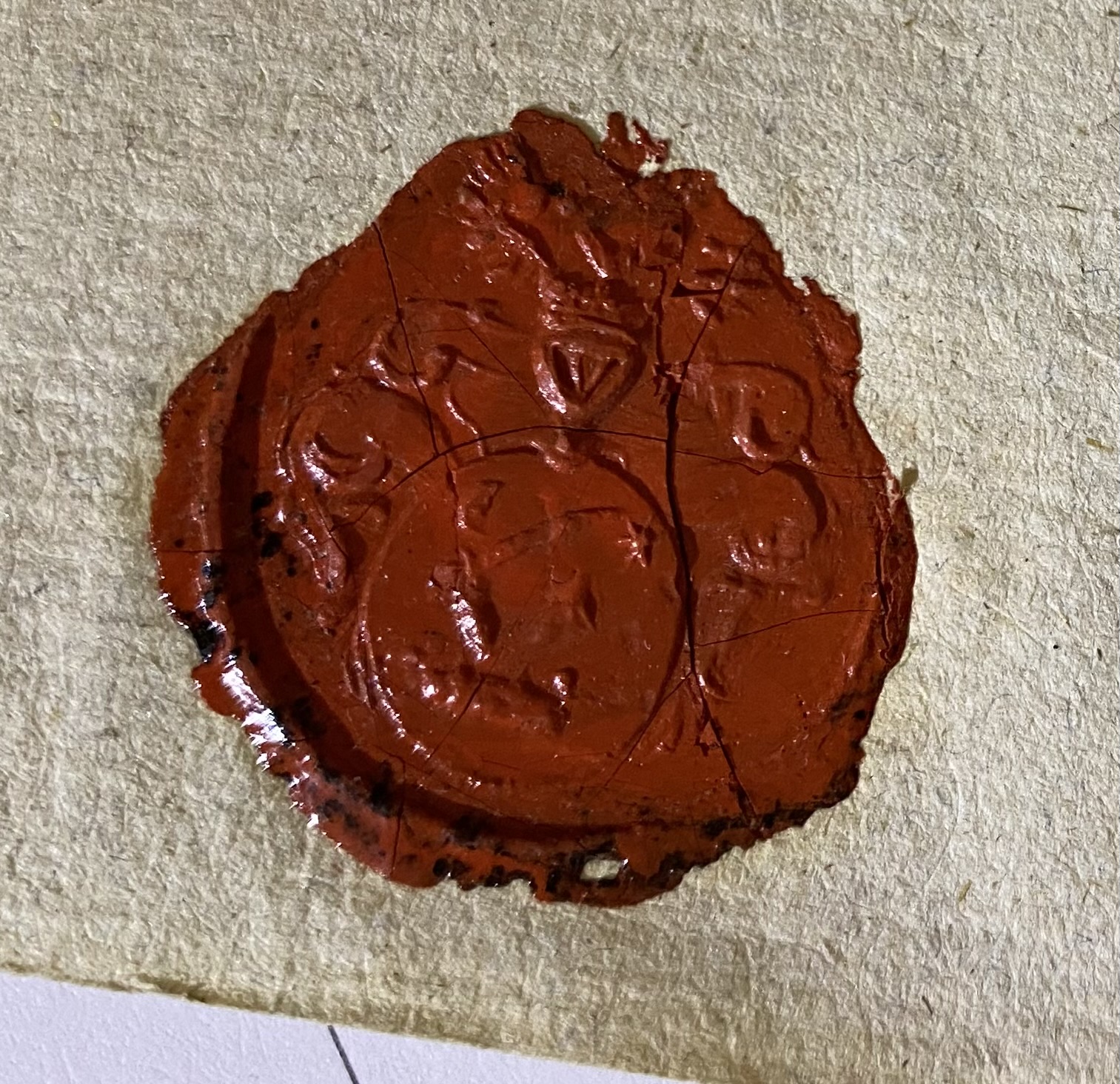 Seal of the Mórocz de Nagyabony family from 1823
This historical seal of the Morocz de Nagyabony family, pressed into red wax, is an authentic testimony to the heraldic symbolism of this prominent house. In the central shield of the seal dominates an armored arm grasping a sword, which is a direct reference to military merit and the defense of the territory during the anti-Ottoman wars. In the upper corners of the shield are traditional heraldic symbols – a crescent on the left and a star on the right, which underscore the nobility of the lineage and the period symbolism of vigilance. Beneath the main motif of the arm is a green branch, which in heraldry often symbolizes victory or the enduring vitality of the family. As a crest above the helmet, eagle wings are depicted, which in combination with the other elements form a complete image of a proud noble house firmly linked to the history of Nagyabony.
Royal Donation of 1719: Gregorius Morocz and the Confirmation of Ancestral Rights
A key historical document for the families of Nagyabony is the charter of Emperor Charles VI dated September 11, 1719. This donation definitively confirmed the property claims of the "illustrious and noble" (Egregij & Nobiles) noblemen to the territories their families defended during the Ottoman threat. A prominent figure in the text is Gregorius Mórocz (recorded as Georgio in the charter due to a clerical error), who, as the grandson of Ambrosius Morocz, directly continued the legacy of his ancestors.
The charter is exceptionally important because it explicitly states that these estates in the locations of Nádvar, Tomogy, and Nagy Abony were held by these families „ab immemoriali“ (since time immemorial). Thus, the monarch was not creating a new claim but confirming an ancient right belonging to them "perpetually and irrevocably" as a reward for their unwavering loyalty to the Crown during times of greatest peril.
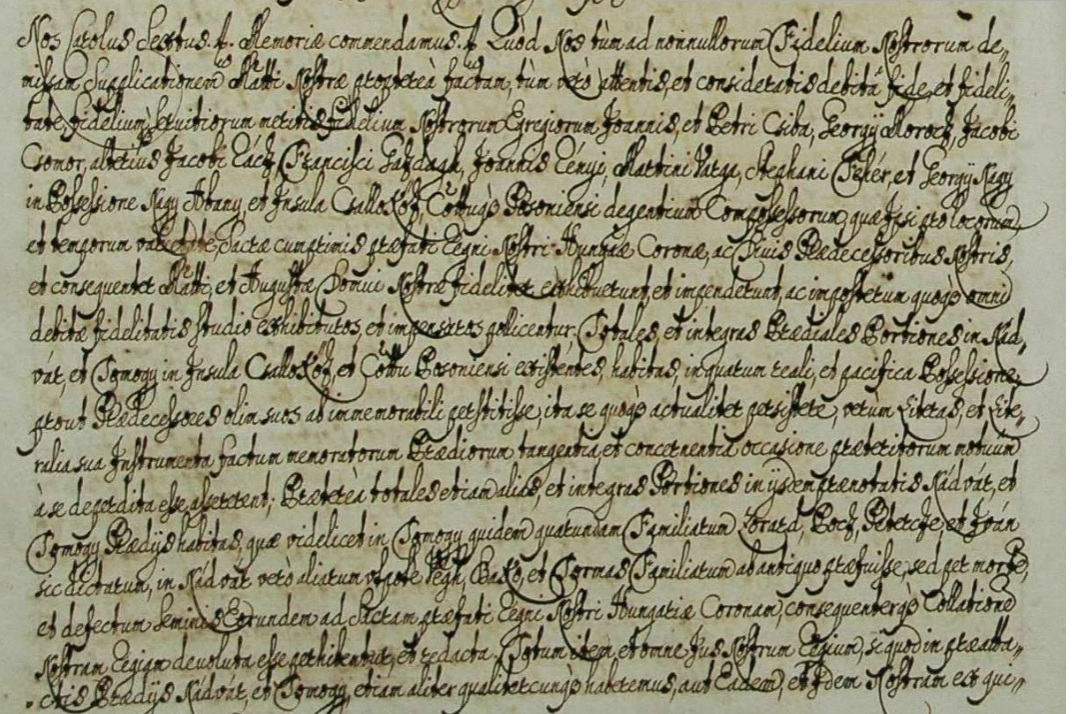 Charter from 1719 by King Charles VI
This crucial section of the charter confirms to the noblemen of Nagyabony full and complete curial shares in the locations of Nádvár and Tomogy. The monarch recognizes that they remain in actual and peaceful possession just as their predecessors did since time immemorial, accepting the fact that the original deeds were lost during past wartime unrest. In addition to confirming ancient rights, the monarch extends the families' estates through this act. He grants them shares previously held by several local families that had existed in both locations since ancient times but, following their extinction in the male line (extinction of the seed) and lack of offspring, reverted to the Crown as an escheat. The Crown now definitively transfers these to the new owners and their heirs in recognition of their demonstrated loyalty.
In addition to Gregorius Mórocz, the charter mentions and confirms these ancient rights for the families: Csiba János, Péter, Csomor Jakab, Rácz Jakab, Gazdagh Ferenc, Rényi János, Varga Márton, Fehér István, and Nagy György.
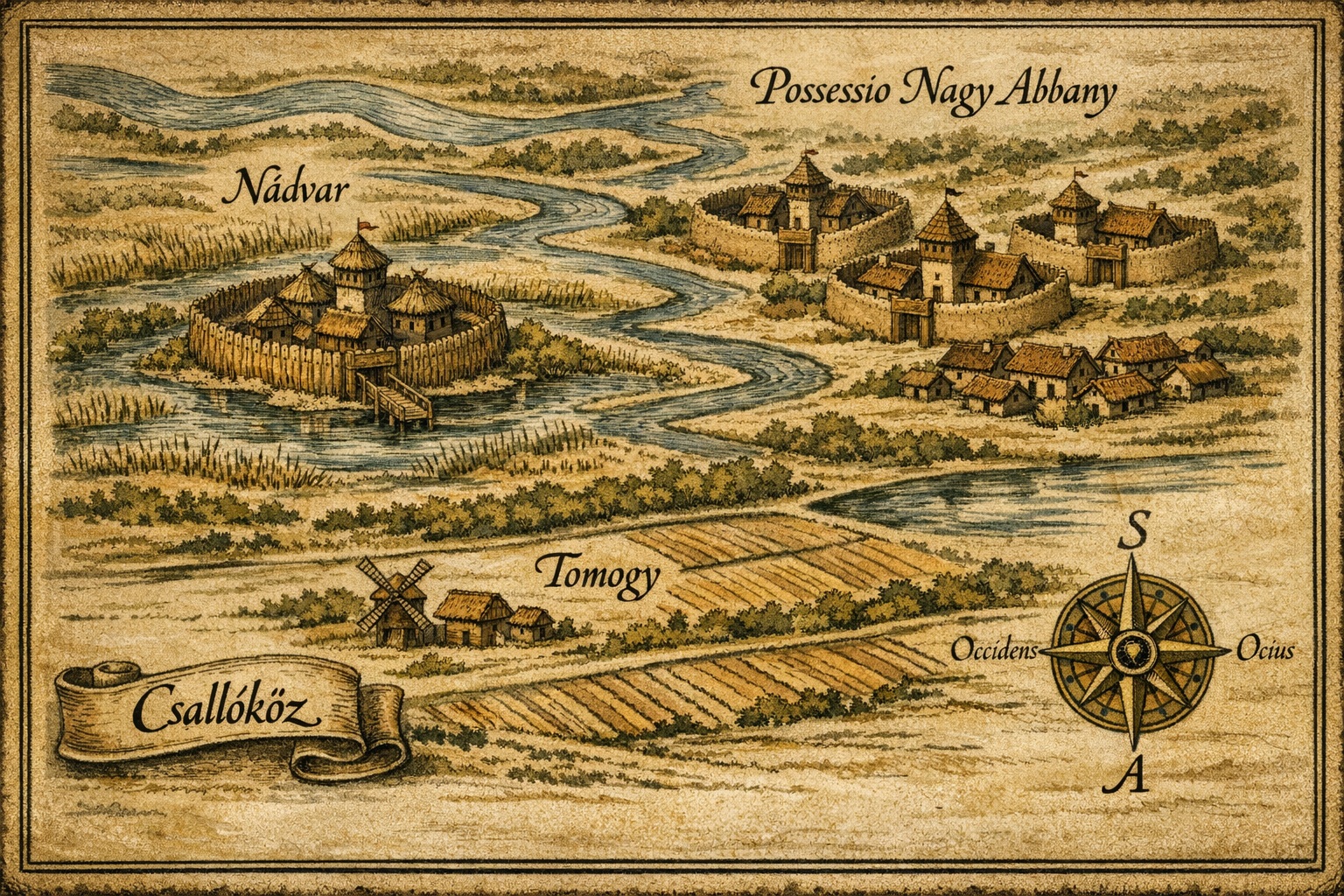 Historical map of the Nagyabony area (Rye Island) showing fortified manors, the Nádvar water fortress, and the Tomogy agricultural fields with a windmill
This map represents a historical reconstruction of the Nagyabony area and its surroundings, created based on preserved written sources and topographical descriptions. In the upper right part, the village itself dominates under the Latin name Possessio Nagy Abbany, consisting of several noble manors protected by high wooden palisades and watchtowers. This depiction highlights the "yeoman" or noble character of the settlement in the 17th and 18th centuries, when the security of ancestral seats was paramount. Towards the left lies the location of Nádvar, portrayed as a typical water fortress built directly into a marshy branch of the river. Its circular fortification and access bridge accurately capture the original meaning of the name as a refuge amidst the reeds. The lower part of the map belongs to the location of Tomogy, where agricultural life is captured instead of walls. We see vast fields and a wooden windmill, suggesting that this part of the territory served primarily for agricultural purposes and grain processing.
Inquire / Share
Would you care to share your knowledge regarding the House of Mórocz de Nagyabony, or do you have inquiries concerning this lineage? Pray, send us a message.